NEET Mock Test Score Analyzer
Enter your mock test results to calculate your score and receive strategic feedback based on NEET marking schemes.
Statistics
- Accuracy: 0%
- Attempt Rate: 0%
- Penalty Marks: 0
Strategic Feedback
You’ve read the books. You’ve attended the lectures. But when you sit down to solve a question, your mind goes blank. This is the most common trap for NEET aspirants. Knowing the material and scoring high marks are two completely different skills. The gap between them is filled by one thing: strategic practice.
In 2026, with over 2 million candidates competing for roughly 100,000 medical seats, simply "studying hard" isn't enough. You need to practice smart. This guide breaks down exactly how to structure your daily practice, what materials to use, and how to analyze your mistakes so that every hour you spend studying translates into actual rank improvement.
The Foundation: Why NCERT Is Non-Negotiable
Before you touch a single question bank, you must understand the source of truth. For Biology, the NCERT textbooks are not just a reference; they are the bible. In recent years, nearly 90% of Biology questions in NEET have been directly or indirectly derived from these texts. If you are practicing from third-party guides without mastering NCERT first, you are building a house on sand.
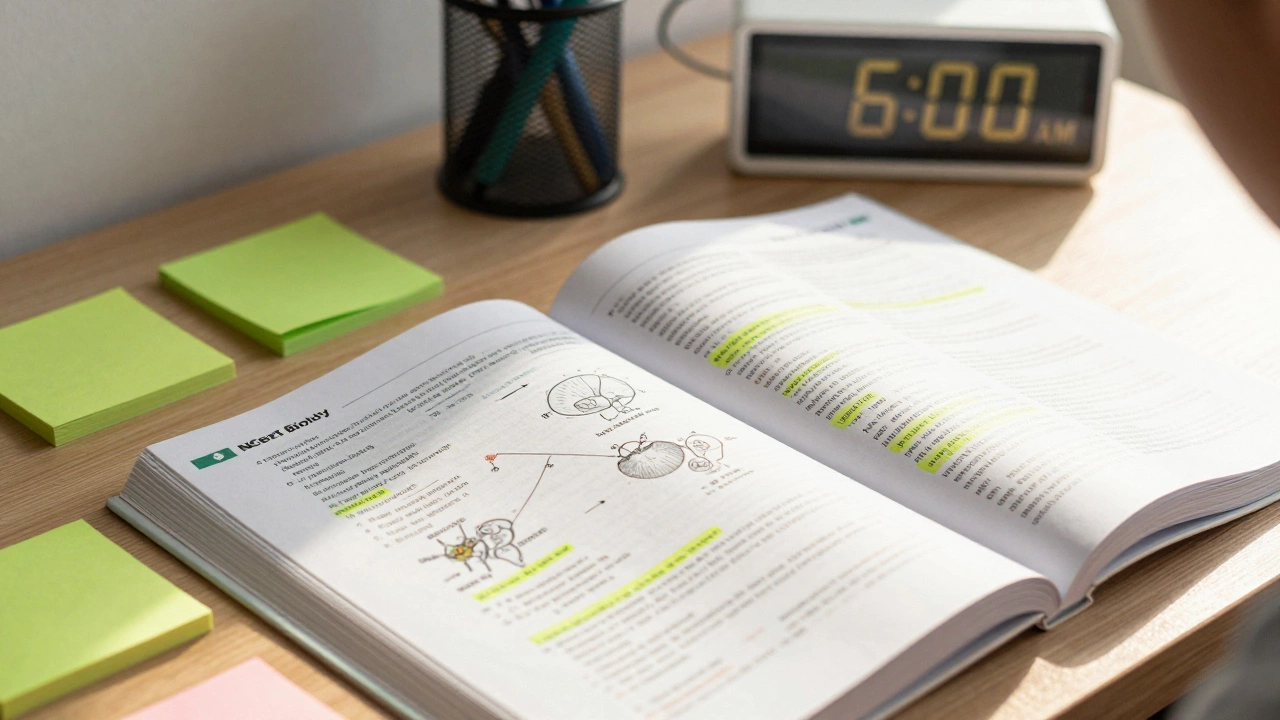
Your practice routine should start with line-by-line reading of NCERT. Don’t just read it-interrogate it. After each paragraph, close the book and ask yourself: "What was the key concept here?" Then, look at the diagrams. Many questions come from captions and images that students skim over. Treat every diagram as a potential question stem.
For Physics and Chemistry, NCERT provides the theoretical framework, but you need to supplement this with problem-solving. However, always cross-reference your concepts back to the textbook to ensure you aren't missing subtle definitions that examiners love to test.
Daily Practice: The Right Mix of Questions
Many students make the mistake of only solving full-length mock tests on weekends. This is inefficient. Your daily practice should be granular and focused. Here is a sustainable daily structure:
- Topic-Specific Quizzes (TSQs): Immediately after finishing a chapter, solve 30-50 questions specific to that topic. This reinforces memory while the information is fresh. Aim for accuracy, not speed, at this stage.
- Previous Year Questions (PYQs): Solve last 10 years' NEET and AIPMT questions for that same chapter. This helps you understand the examiner's mindset and the recurring patterns in questions.
- Formula & Reaction Drills: Spend 15 minutes every morning revising Physics formulas and Chemistry reactions. Write them out manually. Muscle memory plays a surprising role in recall during high-pressure exams.
Avoid jumping into random mixed-question sets too early. It leads to confusion and wasted time. Stick to chapter-wise practice until you have covered at least 80% of the syllabus.
Mock Tests: Simulating the Real Pressure
Once you have a solid grasp of individual chapters, you must shift to full-length NEET Mock Tests. These are critical for three reasons: stamina, time management, and stress inoculation.
NEET is a 3-hour exam with 180 questions (effectively 190 if you count the internal choices). That gives you less than 60 seconds per question. Most students fail because they run out of time, not because they don’t know the answers. You need to take at least one full mock test every week, ideally under strict exam conditions: no phone, no breaks, and a fixed start time (usually 2 PM).
Here is how to approach your mock test strategy:
- Attempt Order: Start with your strongest subject. For many, this is Biology. Securing easy marks early builds confidence and ensures you don’t leave simple points unattempted due to fatigue later.
- The Two-Pass System: In your first pass, answer all questions you know instantly. Mark the difficult ones for review. In your second pass, tackle the marked questions. If you’re still stuck after 2 minutes, guess intelligently and move on.
- Negative Marking Awareness: Remember, -1 mark for every wrong answer. Never guess blindly. If you can eliminate two options, your probability rises to 50%, making an educated guess statistically viable. If you can’t eliminate anything, skip it.

The Art of Analysis: Where the Real Learning Happens
Taking a mock test is useless if you don’t analyze it. In fact, the analysis phase is more important than the test itself. This is where you identify your weak spots and fix them before the real exam.
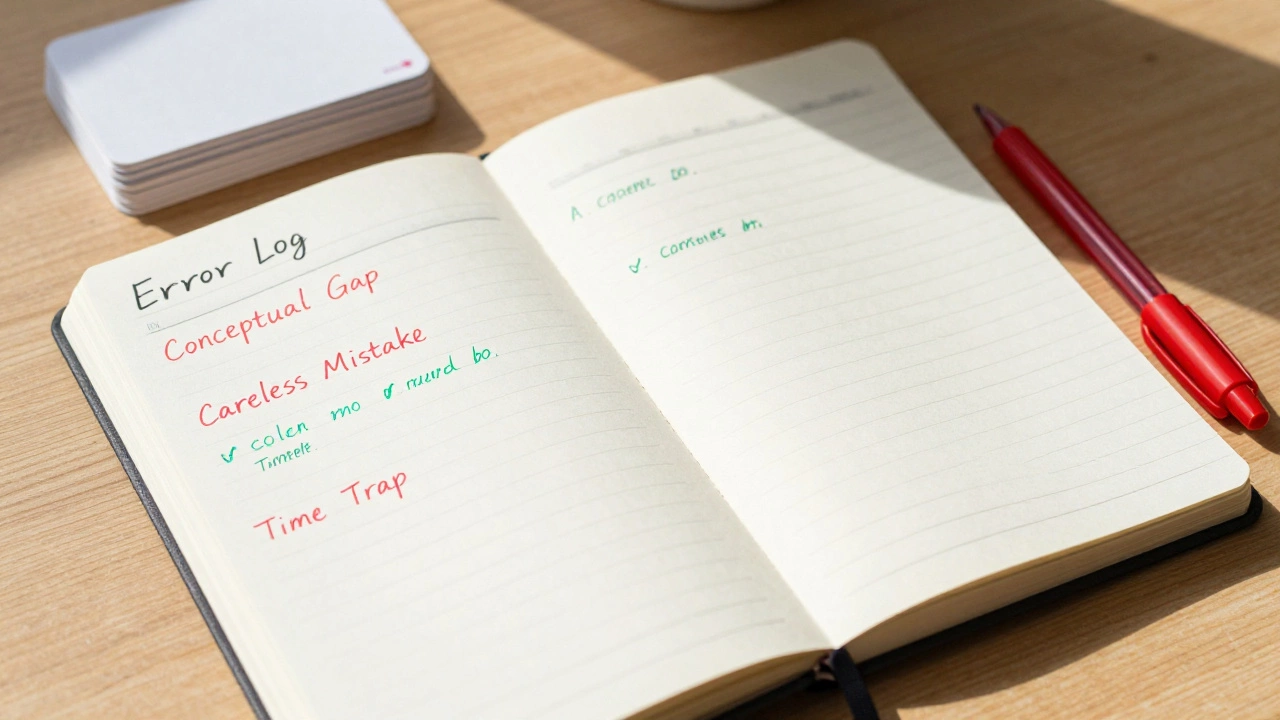
Create an Error Log. This is a dedicated notebook or digital document where you record every mistake you make in practice tests. Categorize your errors into three types:
| Error Type | Description | Action Plan |
|---|---|---|
| Conceptual Gap | You didn't know the theory or formula. | Go back to NCERT or coaching notes. Re-read the concept. Solve 5 more basic problems on it. |
| Careless Mistake | You knew the answer but misread the question or made a calculation error. | Practice mindfulness. Slow down your reading speed. Double-check calculations. |
| Time Trap | You spent too long on one question and rushed others. | Stick to the 60-second rule. Practice skipping difficult questions immediately. |
Review your Error Log every Sunday. If you see a pattern-for example, consistently getting Organic Chemistry reaction mechanisms wrong-you need to dedicate extra time to that specific area in the coming week.
Subject-Wise Practice Tactics
Each subject requires a different approach to practice. Treating them all the same will cost you valuable ranks.
Biology: Memory and Precision
Biology is the rank-decider. It carries 360 marks. Your practice here should focus on retention and precision. Use flashcards for terminologies, especially in Botany and Zoology. Practice labeling diagrams. Pay attention to exceptions in biological rules-they are favorite targets for tricky questions.
Chemistry: The Three Pillars
Chemistry is divided into Physical, Organic, and Inorganic. Physical Chemistry is like Math; you must solve numericals daily. Focus on units and dimensions to avoid silly errors. Organic Chemistry requires understanding mechanisms, not rote memorization. Draw reaction pathways repeatedly. Inorganic Chemistry is pure NCERT. Memorize trends, exceptions, and named reactions. Create short notes for quick revision.
Physics: Application Over Theory
Physics is often the most feared subject. To conquer it, stop trying to derive every formula. Instead, learn to apply standard results quickly. Practice dimensional analysis to check your answers. If you get stuck, look at the options. Sometimes, unit analysis or extreme value substitution can help you find the correct answer without full calculation.
Revision Cycles: Beating the Forgetting Curve
Human brains are wired to forget. Without active revision, you will lose 50% of what you studied within a week. Implement a spaced repetition system:
- Day 1: Learn new content.
- Day 3: Quick revision of Day 1 content (15 mins).
- Day 7: Medium revision (30 mins) + solve 10 MCQs on the topic.
- Day 30: Final revision before moving to new topics.
This ensures that old topics remain fresh in your long-term memory. Don’t wait until the last month to revise everything. By then, it will feel like learning it for the first time again.
Common Pitfalls to Avoid
Even diligent students fall into traps that hinder their progress. Watch out for these:
- Hoarding Resources: Having 10 different books doesn’t help. Master 2-3 good resources (like NCERT, a standard reference book, and a question bank) rather than skimming through dozens.
- Ignoring Health: Sleep deprivation kills concentration. Aim for 7-8 hours of sleep. Exercise regularly to keep stress levels in check. A tired brain makes careless mistakes.
- Comparing Progress: Everyone learns at their own pace. Comparing your mock test scores with friends creates unnecessary anxiety. Focus on your own improvement trajectory.
Final Month Strategy
In the last 30 days, stop learning new things. Shift entirely to revision and mock tests. Take a mock test every alternate day. Analyze each one thoroughly. Revise your Error Log and short notes daily. Keep your mind calm and confident. Trust the process you have built over the past year.
How many hours should I practice for NEET daily?
Quality matters more than quantity. Most successful students practice effectively for 10-12 hours a day, including self-study, coaching classes, and revision. However, if you are a working student or in school, aim for 6-8 focused hours. Consistency is key-studying 4 hours every day is better than 14 hours once a week.
Is it necessary to join a coaching institute for NEET practice?
Not necessarily. While coaching institutes provide structured schedules, test series, and peer competition, many students succeed through self-study. If you have discipline and access to good resources (NCERT, previous year papers, online mock tests), you can prepare independently. Coaching is helpful if you struggle with self-motivation or lack guidance.
Which subjects should I prioritize in my practice?
Biology should be your top priority as it has the highest weightage (360 marks) and is generally easier to score well in. Chemistry follows closely, especially Inorganic and Organic parts which are NCERT-based. Physics requires consistent numerical practice. Balance your time according to your strengths and weaknesses, but never neglect Biology.
How do I handle negative marking in NEET?
Never guess randomly. Only attempt a question if you are sure of the answer or can eliminate at least two options. If you can narrow it down to two choices, there’s a 50% chance of being right, which is statistically worth the risk. Otherwise, skip the question to preserve your score. Practice this decision-making skill in mock tests.
When should I start taking full-length mock tests?
Start taking full-length mock tests once you have completed at least 70-80% of the syllabus. This usually happens around 6-8 months before the exam. Early mock tests help you build stamina and identify gaps, while later tests refine your speed and accuracy. Aim for at least 30-40 full mocks before the actual exam.