CBSE School Location Finder
Find CBSE Schools by Country
How It Works
Our tool shows the number of CBSE-affiliated schools in your selected country, estimated cost ranges, and availability of JEE/NEET exam centers. Results are based on current data from CBSE and parent reports.
CBSE School Information
Number of Schools
Annual Cost Range
JEE/NEET Exam Availability
Recommended Areas
Many parents and students wonder if the CBSE syllabus exists beyond India’s borders. The answer is yes-but not in the way you might think. CBSE, or the Central Board of Secondary Education, doesn’t send its curriculum overseas like a franchise. Instead, Indian schools abroad, run by Indian expats or international education groups, choose to follow CBSE’s structure to keep their students connected to India’s education system.
Where Can You Find CBSE Schools Outside India?
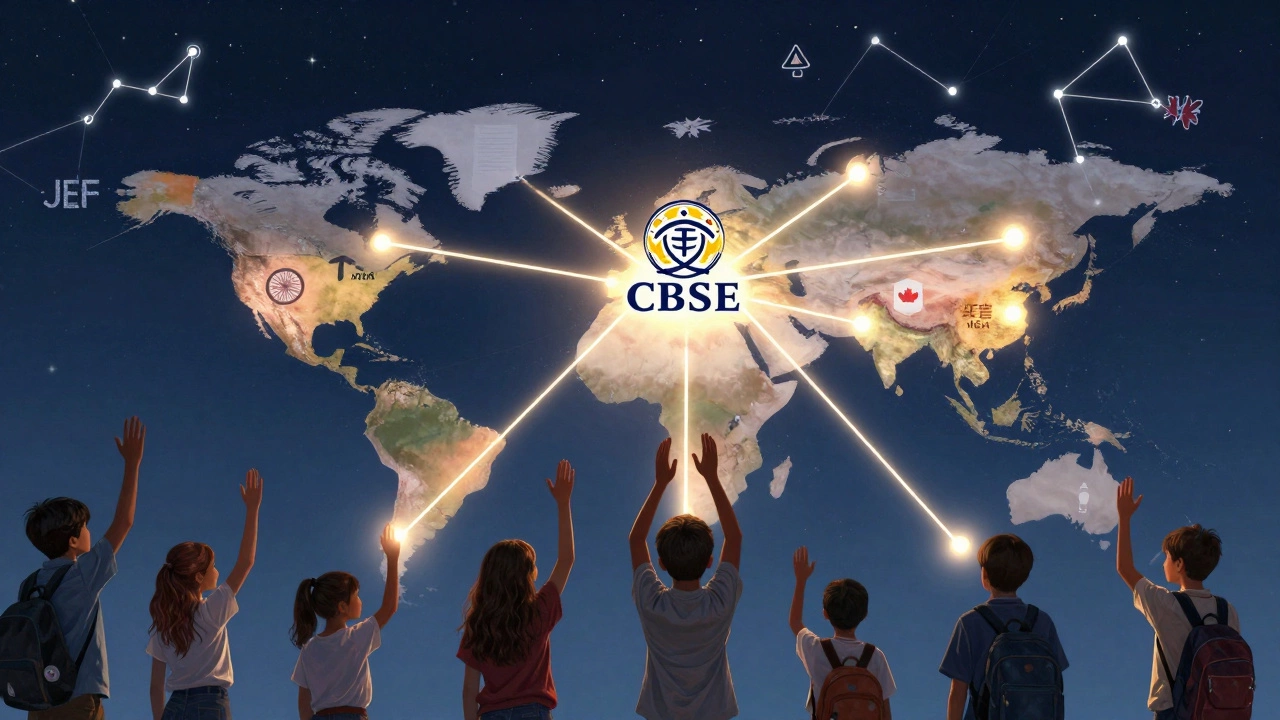
CBSE-affiliated schools exist in over 25 countries. The largest clusters are in the Gulf region-UAE, Saudi Arabia, Qatar, Oman, and Kuwait-where millions of Indian expatriates live. You’ll also find them in countries like the USA, Canada, the UK, Australia, South Africa, and even in places like Nepal and Sri Lanka. These schools are usually run by Indian diaspora communities or private education trusts that want to offer an Indian-style education to children of overseas Indians.
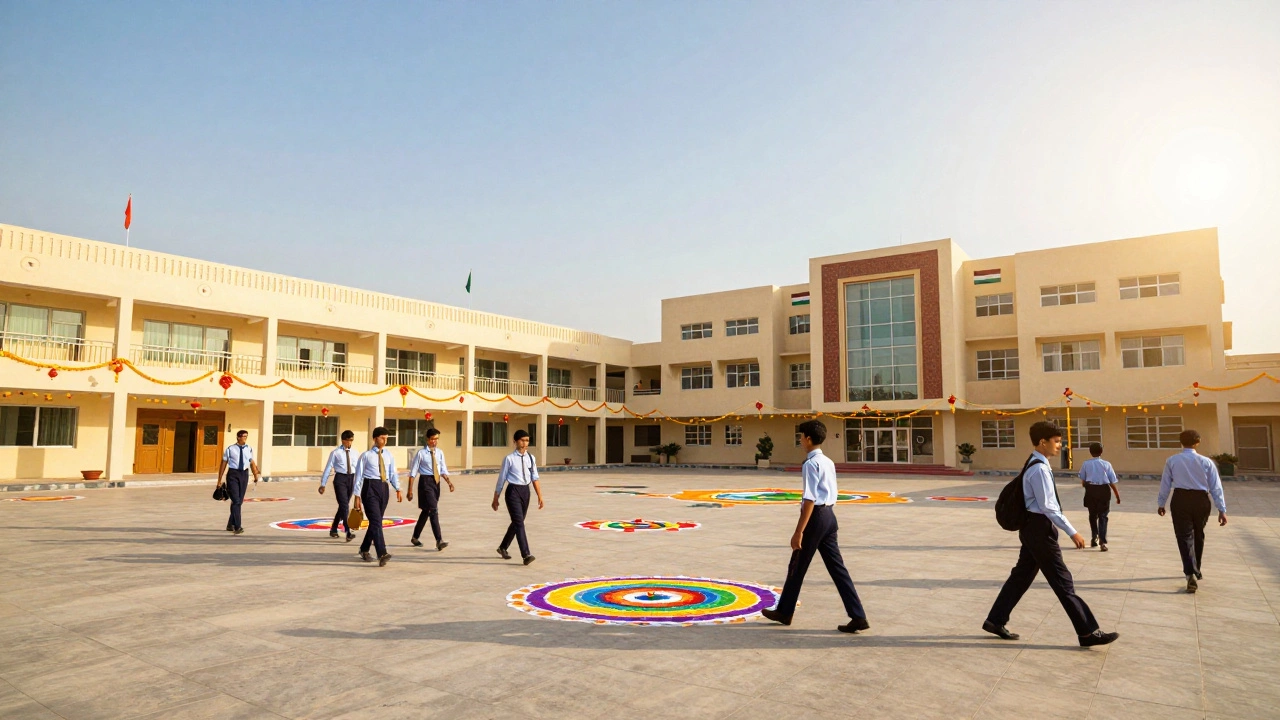
In the UAE alone, there are more than 150 CBSE schools. Dubai and Abu Dhabi have entire campuses built around the CBSE curriculum, complete with Hindi classes, Indian festivals, and syllabi that match what’s taught in Delhi or Chennai. In Australia, cities like Sydney, Melbourne, and Brisbane have a handful of CBSE schools catering to Indian families who want their kids to stay on track for competitive exams like JEE or NEET back home.
How Is CBSE Different Abroad?
While the core syllabus stays the same-especially for subjects like Math, Science, and Social Studies-some adjustments happen. Schools outside India often reduce the number of regional language options. For example, Hindi might be the only Indian language offered, instead of Tamil, Telugu, or Bengali. Some schools also adjust exam schedules to fit local holidays or academic calendars.
Practical labs and projects still follow CBSE guidelines, but access to resources can vary. A school in Sydney might use locally available materials for a biology experiment, while a school in Dubai might have better lab equipment than some schools in rural India. The board doesn’t enforce uniformity in infrastructure abroad-it only checks that the curriculum is delivered as prescribed.
Why Do Families Choose CBSE Overseas?
There are three main reasons. First, consistency. If a family moves from Mumbai to London, they don’t want their child to restart the entire education system. CBSE offers a familiar structure, textbooks, and exam patterns. Second, future planning. Many students plan to return to India for college and need to sit for JEE, NEET, or CUET-all of which are designed for CBSE syllabus. Third, community. CBSE schools abroad often become cultural hubs. They celebrate Diwali, organize Indian dance competitions, and hire teachers from India who understand the expectations.
One parent in Toronto told me their daughter switched from the Ontario curriculum to a local CBSE school after two years. “She was struggling with the open-ended projects. In CBSE, she knew exactly what to study. Her confidence came back,” they said. That’s not unusual.

Is CBSE Accepted by Universities Abroad?
Yes, but not automatically. Universities in the USA, UK, Canada, and Australia recognize CBSE as a valid secondary qualification. However, they don’t treat it the same as local high school diplomas. For example, a CBSE Class 12 certificate is often evaluated alongside standardized tests like SAT, ACT, or IELTS. Some universities require a credential evaluation from agencies like WES or ECE to convert CBSE grades into their own scale.
Top universities like the University of Toronto, University of Manchester, and University of Melbourne have admitted hundreds of CBSE students each year. But they look at more than just marks. Extracurriculars, personal statements, and recommendation letters matter just as much. CBSE students often excel in math and science, which helps for STEM programs. But if a student wants to study arts or design, they might need to build a stronger portfolio than their peers from IB or A-Levels.
CBSE vs IB vs Cambridge: What’s the Difference?
Many families compare CBSE with IB (International Baccalaureate) or Cambridge IGCSE/A-Levels. Here’s how they stack up:
| Feature | CBSE | IB Diploma | Cambridge IGCSE/A-Levels |
|---|---|---|---|
| Curriculum Focus | Subject-based, exam-driven | Holistic, interdisciplinary | Subject-focused, in-depth |
| Language Options | Indian languages + English | Multiple languages, including native | English only |
| Assessment Style | Final exams, memorization-heavy | Coursework + exams + TOK + EE | Final exams + some coursework |
| Recognition in India | Highly recognized | Recognized, but less familiar | Recognized, but less common |
| Recognition Abroad | Good, needs evaluation | Excellent, globally accepted | Excellent, widely accepted |
| Best For | Students planning to return to India for college | Students aiming for global universities | Students targeting UK, Australia, or Canada |
IB and Cambridge are more common in international schools because they’re designed for global mobility. CBSE is chosen when staying connected to India is the priority. It’s not better or worse-it’s about what you need.
What About Exams Like JEE and NEET?
CBSE students abroad can still take JEE and NEET. The National Testing Agency (NTA) allows overseas students to register for these exams. There are test centers in Dubai, Kuwait, Singapore, and even in cities like Sydney and London. You don’t need to fly back to India to sit for them.
But here’s the catch: preparation is harder. Coaching centers like Allen or Kota don’t exist overseas. Students rely on online courses, YouTube tutorials, and self-study. Many CBSE schools abroad now offer optional JEE/NEET prep classes, but they’re not mandatory. It’s up to the student and family to stay disciplined.
Is CBSE the Right Choice for Your Child Abroad?
Ask yourself these questions:
- Do you plan to return to India for college? If yes, CBSE is a safe bet.
- Is your child strong in memorization and structured learning? CBSE rewards that.
- Are you okay with less emphasis on creativity and critical thinking compared to IB or A-Levels?
- Can you support your child’s exam prep without local coaching?
If you’re planning to settle permanently abroad and your child wants to study at a top university in the US or UK, IB or Cambridge might give them a smoother path. But if you want your child to keep their Indian academic identity, CBSE works-and it’s growing.
How to Find a CBSE School Overseas
The CBSE website lists affiliated schools abroad. Go to cbse.gov.in, click on “Affiliated Schools,” then select “Outside India.” You’ll see a downloadable PDF with names, addresses, and contact details. Always verify the affiliation directly with the school. Some institutions claim to follow CBSE but aren’t officially recognized.
Also check reviews from current parents. Look for schools that have been running CBSE for more than five years. Newer schools might lack experienced teachers or proper exam coordination.
Final Thoughts
CBSE isn’t just an Indian system-it’s a lifeline for millions of Indian families living overseas. It keeps kids grounded in a familiar academic culture while giving them a clear path to higher education in India. It’s not perfect. It’s not as flexible as other systems. But for families who want their children to speak Hindi at home, celebrate Holi at school, and still sit for JEE in Dubai-it’s the only system that makes sense.
So yes, CBSE exists outside India. And it’s thriving-not because the board pushed it abroad, but because parents chose it, one family at a time.
Can I take CBSE board exams from another country?
Yes. CBSE allows students enrolled in affiliated schools abroad to appear for Class 10 and Class 12 board exams. Exams are conducted in designated centers in countries like the UAE, Saudi Arabia, Singapore, the UK, USA, Canada, Australia, and South Africa. You must register through your school, not individually.
Is CBSE easier than IB or Cambridge?
It depends on what you mean by “easier.” CBSE has a more structured, exam-focused approach with less emphasis on projects or internal assessments. Students who memorize well and handle pressure do better. IB and Cambridge require more independent research, critical thinking, and consistent coursework. Neither is objectively easier-they suit different learning styles.
Do CBSE schools abroad follow the same textbooks?
Yes. Most CBSE-affiliated schools overseas use NCERT textbooks, the same ones used in India. Some schools supplement with local editions or digital versions, but the content aligns with CBSE’s prescribed syllabus. Teachers are often trained in India or certified by CBSE.
Can I switch from CBSE to another curriculum later?
Yes, but it can be challenging. Switching from CBSE to IB or A-Levels in Grade 11 or 12 means catching up on different teaching styles, coursework, and assessment methods. It’s easier to switch earlier, like from Grade 8 or 9. Many students who switch later struggle with the shift from rote learning to analytical writing.
Are CBSE schools abroad expensive?
They vary. In the Gulf, CBSE schools can cost between $5,000 and $15,000 per year. In Australia or Canada, fees range from $10,000 to $20,000 annually-often higher than local public schools but lower than top IB schools. The cost reflects infrastructure, teacher salaries, and exam coordination fees paid to CBSE.