
Online Degree Flexibility Analyzer
Select a major below to see detailed analysis of its flexibility level, typical assessments, and ideal candidate profile.
Let’s be honest: life doesn’t stop just because you decided to get a degree. Between work deadlines, family obligations, and the general chaos of modern living, finding time for rigorous academic study feels like an impossible task. You want a credential that boosts your career or satisfies a personal goal, but you don’t have the energy for a traditional four-year grind with late-night lab sessions and mandatory campus attendance. So, the question on everyone’s mind is simple: what is the easiest degree to get online? The answer isn’t about finding a diploma mill or cheating the system; it’s about identifying programs designed for flexibility, credit transfer, and adult learners.
Defining "Easy" in Higher Education
Before we look at specific majors, we need to redefine what "easy" actually means in this context. An easy degree isn’t one where you can skip class and still pass. It is a program that respects your time and leverages your existing experience. When searching for the path of least resistance, you are looking for three key features: generous credit transfer policies, competency-based learning models, and asynchronous coursework. These elements remove the friction from studying, allowing you to move through material at your own speed rather than fighting against a rigid semester calendar.
The Best Majors for Low-Stress Completion
Some fields of study are inherently more structured around theory and writing, while others rely heavily on complex calculations or hands-on clinical hours. For the online student seeking efficiency, humanities and social sciences often present the smoothest path. Here are the top contenders for the most manageable online degrees.
Humanities is a broad category that includes subjects like English, History, Philosophy, and Communication. These majors typically require less specialized software or expensive lab equipment. Your assessments usually consist of essays and research papers, which allow you to demonstrate understanding in ways that fit your schedule. If you enjoy reading and writing, these subjects feel less like a chore and more like an extension of your daily interests.
Criminal Justice is another popular choice for working adults. Many people already work in law enforcement, security, or corrections and want to advance their careers without starting from scratch. Online Criminal Justice programs are designed to accommodate shift workers. The curriculum focuses on policy, procedure, and sociology rather than intense forensic science labs. It is practical, direct, and highly relevant to those already in the field.
Business Administration offers a versatile foundation that applies to almost any industry. Unlike accounting, which requires precise mathematical accuracy, business administration covers management, marketing, and organizational behavior. These concepts are often intuitive for people who have held supervisory roles. The coursework tends to be case-study based, allowing you to apply real-world logic rather than memorizing abstract formulas.
Sociology explores human behavior and societal structures. It is a major that encourages critical thinking and discussion rather than rote memorization. For many students, discussing social trends and cultural dynamics is engaging and less stressful than tackling advanced mathematics or scientific theories. It also pairs well with other interests, making it a strong liberal arts option.
Why Liberal Arts Beat STEM for Flexibility
If you are looking for the absolute easiest route, you will likely find that STEM (Science, Technology, Engineering, and Mathematics) degrees pose significant hurdles online. While coding and data science are valuable, they often require synchronous lab times, specialized hardware, or strict sequential learning paths. You cannot skip Chapter 3 of a calculus course if you didn’t understand Chapter 2. In contrast, liberal arts degrees offer modular learning. You can tackle modules in a way that suits your cognitive peak hours. This flexibility reduces burnout and makes completion much more achievable for non-traditional students.
The Power of Competency-Based Education
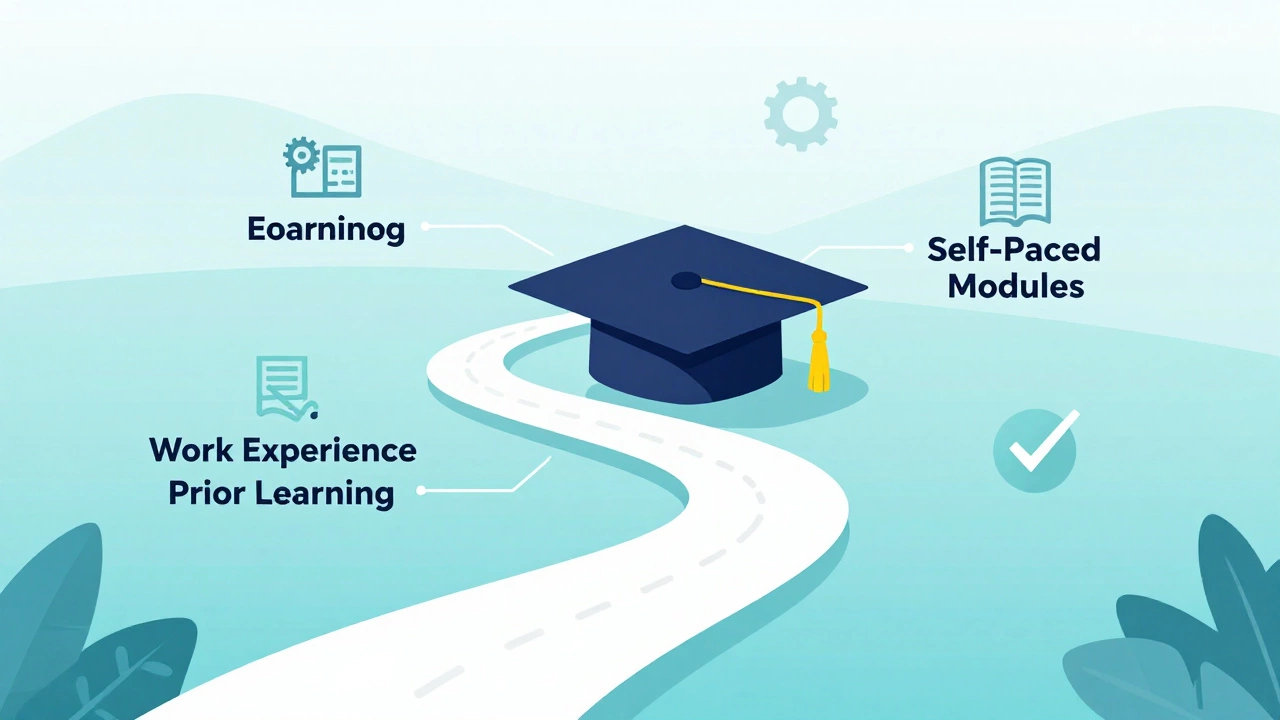
To truly minimize the effort required, you should look beyond just the major and focus on the delivery model. Competency-Based Education (CBE) is a game-changer for adult learners. Instead of sitting through weeks of lectures you’ve already mastered, CBE allows you to prove what you know and move on immediately. Programs like those offered by WGU (Western Governors University) or Thomas Edison State University operate on this principle. You pay per term, not per credit hour, meaning the faster you learn, the cheaper the degree becomes. This model removes the artificial timeline of semesters, letting you finish a year’s worth of work in a few months if you have the capacity.
Leveraging Transfer Credits and Life Experience
The "easiest" degree is often the one you start with half the credits already done. Most online-friendly universities accept credits from community colleges, military training, and professional certifications. Organizations like Ace Credit and NUSAP evaluate prior learning experiences and recommend them for college credit. If you have worked in IT, healthcare, or management for years, you might be able to test out of entire courses. By maximizing transfer credits, you reduce the total number of classes you need to take, significantly lowering the overall workload.
| Major | Typical Assessment Type | Flexibility Level | Best For |
|---|---|---|---|
| Humanities | Essays & Research Papers | High | Writers & Readers |
| Criminal Justice | Case Studies & Quizzes | Very High | Law Enforcement Professionals |
| Business Admin | Projects & Discussions | High | Managers & Entrepreneurs |
| Sociology | Discussions & Reflections | High | Social Workers & Educators |
| Computer Science | Coding Labs & Exams | Medium | Tech Enthusiasts |
Choosing the Right Institution
Not all online universities are created equal. To ensure your degree is respected by employers, you must choose a regionally accredited institution. Accreditation guarantees that the school meets certain quality standards and that your credits will transfer elsewhere if needed. Schools known for supporting adult learners include University of Phoenix, Strayer University, and public state universities with robust online extensions. Avoid unaccredited schools that promise instant diplomas; they are worthless and can damage your professional reputation.
Managing Expectations: No Degree is "Free" Effort
While we are looking for the "easiest" path, it is crucial to manage expectations. Even the most flexible degree requires discipline. You will need to write papers, participate in forums, and complete assessments. The difference lies in the control you have over the process. With the right major and institutional support, you can integrate your studies into your life rather than letting your studies consume your life. It is about smart strategy, not shortcuts.
Steps to Start Your Journey
- Identify Your Goal: Determine why you need the degree. Is it for a promotion, a career change, or personal growth?
- Gather Transcripts: Collect records from previous schooling, including high school, community college, or military training.
- Research Transfer Policies: Look for schools with high transfer limits (often up to 75-90% of degree requirements).
- Choose a Flexible Major: Select from Humanities, Business, or Social Sciences unless your career demands otherwise.
- Apply for Competency-Based Programs: Prioritize schools that allow self-paced learning.
- Create a Study Schedule: Block out consistent time slots each week to maintain momentum.
Frequently Asked Questions
Is an online degree as valuable as a traditional one?
Yes, provided the institution is regionally accredited. Employers increasingly value skills and credentials regardless of how they were obtained. The stigma around online education has largely disappeared, especially for adult learners and professionals.
Can I really get a degree in under two years?
It is possible if you have significant transfer credits or enroll in a competency-based program where you can accelerate your pace. However, for someone starting from zero, a bachelor’s degree typically takes three to four years of part-time study.
What is the cheapest way to get an online degree?
Public state universities often offer lower tuition rates for residents. Additionally, competency-based programs like WGU charge a flat fee per term rather than per credit, which can save thousands if you complete coursework quickly.
Do I need to attend live classes for an online degree?
Most "easy" online degrees are asynchronous, meaning there are no live classes. You log in whenever it fits your schedule. Synchronous programs require attendance at specific times and are generally less flexible for working adults.
Which major is best for job placement after graduation?
While Humanities and Sociology are easier to complete, Business Administration and Criminal Justice often have clearer career pathways. Business degrees are versatile across industries, while Criminal Justice directly supports roles in government and security sectors.
Getting a degree online is less about talent and more about logistics. By choosing a major that aligns with your strengths and a university that respects your time, you transform an overwhelming challenge into a manageable milestone. Focus on flexibility, leverage your past experiences, and pick a path that fits your life, not the other way around.