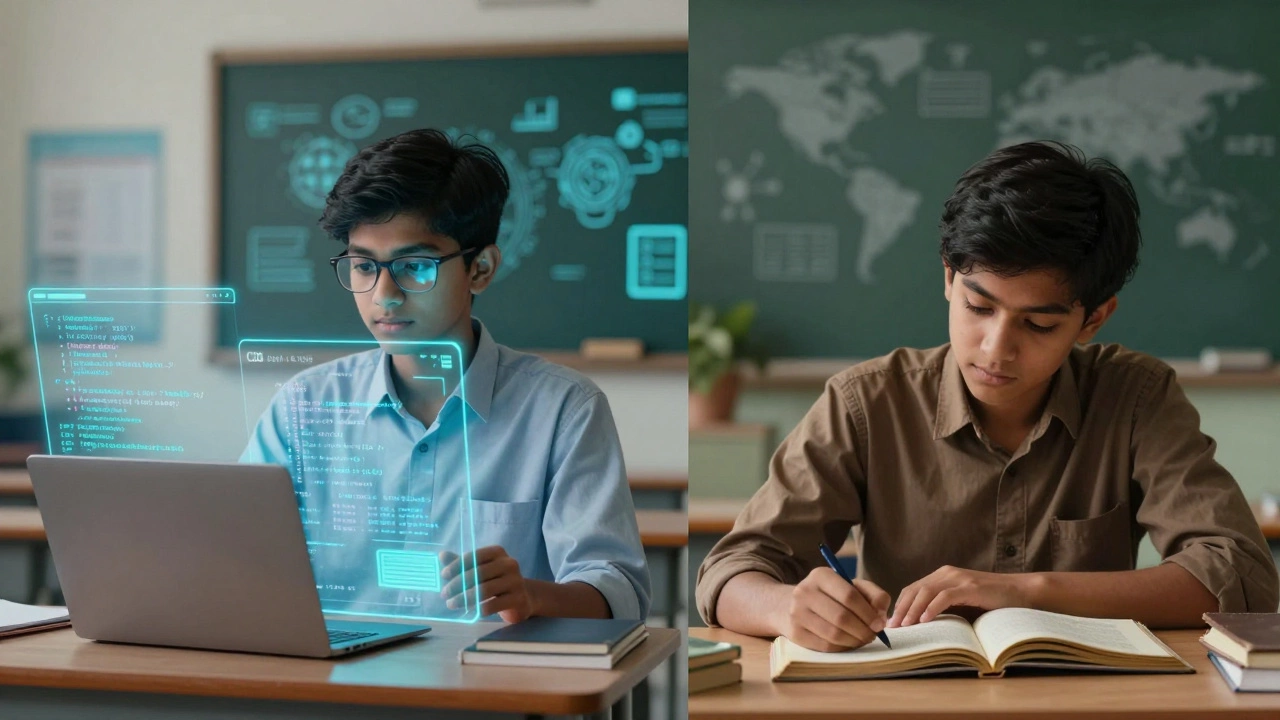
When parents and students ask which board is best for the future, they’re not just asking about textbooks or exam patterns. They’re asking: Which board gives my child the real edge? In 2025, the answer isn’t about tradition-it’s about adaptability, global recognition, and how well the system prepares students for a world that’s changing faster than ever.
Why CBSE Leads in Future-Readiness
CBSE, the Central Board of Secondary Education, isn’t just popular because it’s nationwide. It’s dominant because it’s designed for mobility and modern learning. Over 20 million students across India and in over 250 schools abroad study under CBSE. That’s not an accident. The board actively updates its syllabus every two years, aligning with global standards in science, math, and digital literacy.
For example, CBSE introduced Artificial Intelligence as an elective subject in Class 9 and 10 in 2023. By 2025, every CBSE student has exposure to basic coding, data analysis, and machine learning concepts-skills most state boards still don’t teach until college. This isn’t a luxury. It’s a necessity. Employers and universities now expect students to understand how technology shapes decision-making, not just how to solve equations.
State Boards: Strong Locally, But Falling Behind Globally
State boards like Maharashtra’s MSBSHSE, Tamil Nadu’s SSLC, or West Bengal’s WBCHSE are deeply rooted in regional culture and language. Many students thrive under them, especially in rural areas where local context matters. But here’s the catch: these boards rarely update their curriculum beyond minor tweaks. In 2025, a student in Karnataka studying biology might still be memorizing 1990s-era diagrams while a CBSE peer is analyzing real-time genomic data using online tools.
State boards also lack standardized digital infrastructure. CBSE provides free access to e-content, sample papers, and video lectures through its DIKSHA portal. Most state boards still rely on printed textbooks and occasional online PDFs. If your child plans to take SAT, IELTS, or apply to universities abroad, CBSE’s alignment with international curricula gives them a measurable advantage.
The Exam Advantage: CBSE’s Predictable Structure
CBSE exams follow a clear, consistent pattern. The marking scheme is transparent. Questions are based on NCERT textbooks, which are widely available and well-explained. This predictability reduces exam stress and helps students focus on understanding, not rote learning.
Compare that to some state boards where questions come from obscure regional references or shift unpredictably year to year. A student preparing for JEE or NEET often finds CBSE’s syllabus a perfect match-85% of JEE Main questions in 2024 came directly from CBSE Class 11 and 12 NCERT content. State board students frequently need extra coaching just to bridge the gap.
Higher Education and Career Pathways
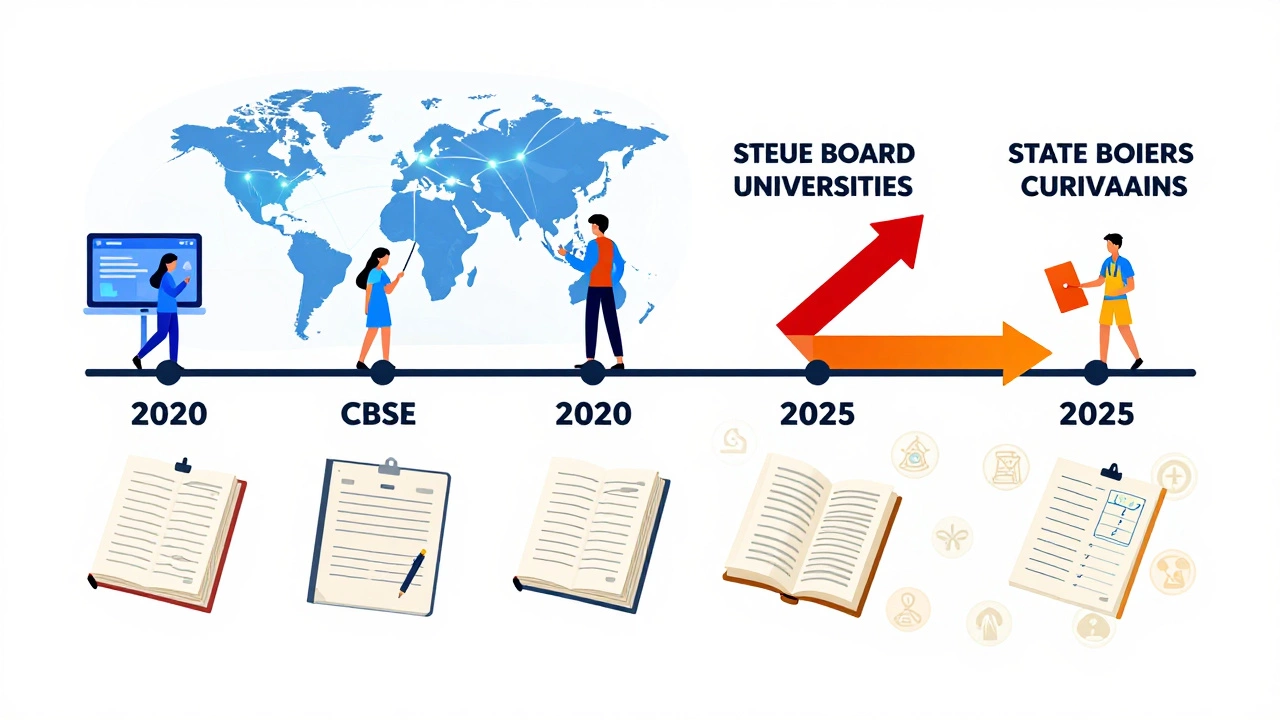
Universities in India and abroad recognize CBSE as a benchmark. The National Institutional Ranking Framework (NIRF) shows that top-ranked engineering and medical colleges in India admit more CBSE students than any other board. Why? Because CBSE students consistently score higher in entrance exams.
Outside India, CBSE is accepted by universities in the US, UK, Canada, Australia, and Germany without additional equivalency tests. State board certificates often require extra documentation, translation, or even retesting. For families planning to move abroad or send their child overseas for higher education, CBSE removes friction.
Even in corporate hiring, especially in tech and multinational firms, CBSE is seen as a signal of exposure to standardized, outcome-based learning. Recruiters don’t always know the difference between boards-but they know CBSE means the student has likely handled structured assessments, digital tools, and project-based learning since Class 6.
What About the Arts and Humanities?
Some argue that state boards are better for arts, literature, or history because they emphasize regional languages and local culture. That’s true-but CBSE has evolved here too. In 2025, CBSE offers electives like Psychology, Sociology, Political Science, and even Indian Classical Music and Fine Arts. The difference? CBSE integrates these subjects with critical thinking and research methods. A history project isn’t just writing dates-it’s analyzing primary sources, comparing global perspectives, and presenting findings digitally.
State boards may offer more local folklore or regional poets, but CBSE gives students the tools to analyze those stories in a global context. That’s what future employers and grad schools want: not just knowledge, but the ability to connect it.
Cost and Accessibility: The Hidden Factor
CBSE schools often cost more, especially private ones. But the real cost isn’t tuition-it’s opportunity. A student from a state board in a small town may struggle to get into a top university without extra coaching. That coaching can cost ₹50,000-₹1,50,000 per year. CBSE students, with their aligned syllabus and free online resources, often need less external help.
Plus, CBSE’s digital ecosystem is free and accessible to anyone with a smartphone. The NCERT app, e-pathshala, and YouTube channels like “CBSE Official” offer full lessons, sample papers, and doubt-solving sessions. State boards rarely provide anything comparable.
What If You’re Already in a State Board?
Switching boards mid-way isn’t always practical. But if you’re in Class 8 or 9 and thinking ahead, here’s what you can do right now:
- Use NCERT textbooks alongside your state syllabus-they’re the gold standard for competitive exams.
- Enroll in free CBSE-aligned online courses on DIKSHA or SWAYAM.
- Practice past CBSE sample papers for Class 10 and 12-even if you’re not taking the exam.
- Focus on digital skills: learn basic Python, use spreadsheets for data, understand how AI tools work.
You don’t need to change boards to think like a CBSE student. You just need to adopt the mindset: learn how to learn, not just what to memorize.
The Bottom Line: Future-Proofing Starts Now
In 2025, the best board isn’t the one with the most history. It’s the one that prepares students for jobs that don’t exist yet. CBSE has built its reputation not by resisting change, but by leading it. It’s the board that brought AI into classrooms before most countries even discussed it. It’s the board that ensures a child in Bihar and a child in Bangalore are learning the same core skills.
That doesn’t mean state boards are bad. They serve their communities well. But if your goal is global mobility, higher education abroad, or a career in tech, healthcare, or innovation-CBSE gives you a clear, proven head start.
The future doesn’t reward tradition. It rewards adaptability. And right now, CBSE is the only board in India that’s built for that.
Is CBSE better than ICSE for the future?
CBSE is generally more aligned with future career paths, especially in STEM fields. While ICSE offers deeper English and literature focus, CBSE’s syllabus is more closely tied to national competitive exams like JEE and NEET, and it integrates digital skills and AI earlier. For students aiming for engineering, medicine, or tech careers, CBSE is the more direct path.
Can I switch from a state board to CBSE in Class 11?
Yes, but it’s challenging. CBSE Class 11 syllabus assumes prior exposure to concepts introduced in Class 10 under CBSE. Students switching often need to catch up on topics like Coordinate Geometry, Basic Chemistry nomenclature, or Python programming. It’s doable with extra effort and tutoring, but starting in Class 9 or 10 is smoother.
Does CBSE help with studying abroad?
Yes. CBSE is recognized by universities in the US, UK, Canada, Australia, and Europe. Many institutions accept CBSE Class 12 marks directly for admission. Some even offer scholarships based on CBSE performance. State boards often require additional verification or equivalency certificates, which can delay applications.
Is CBSE too stressful because of exams?
CBSE exams are structured, not necessarily harder. The board has reduced rote memorization since 2020 and now focuses on application-based questions. Stress often comes from coaching culture, not the board itself. Students who focus on understanding concepts, not just cramming, find CBSE manageable and even empowering.
What if my child is weak in English? Is CBSE still okay?
Yes. While CBSE uses English as the medium of instruction, the language requirements are practical, not literary. Students need to communicate clearly in writing and speaking-not write poetry. Many CBSE schools offer remedial English support. For non-English speaking families, the focus on core subjects like math and science often outweighs language barriers, especially with digital learning tools available.
What Comes Next?
If you’re still deciding, ask this: Where do you see your child in five years? In a local college? Or applying to MIT, ETH Zurich, or IIT Bombay? The board you choose now isn’t just about passing exams-it’s about opening doors. CBSE doesn’t guarantee success, but it gives you the strongest toolkit to build it.