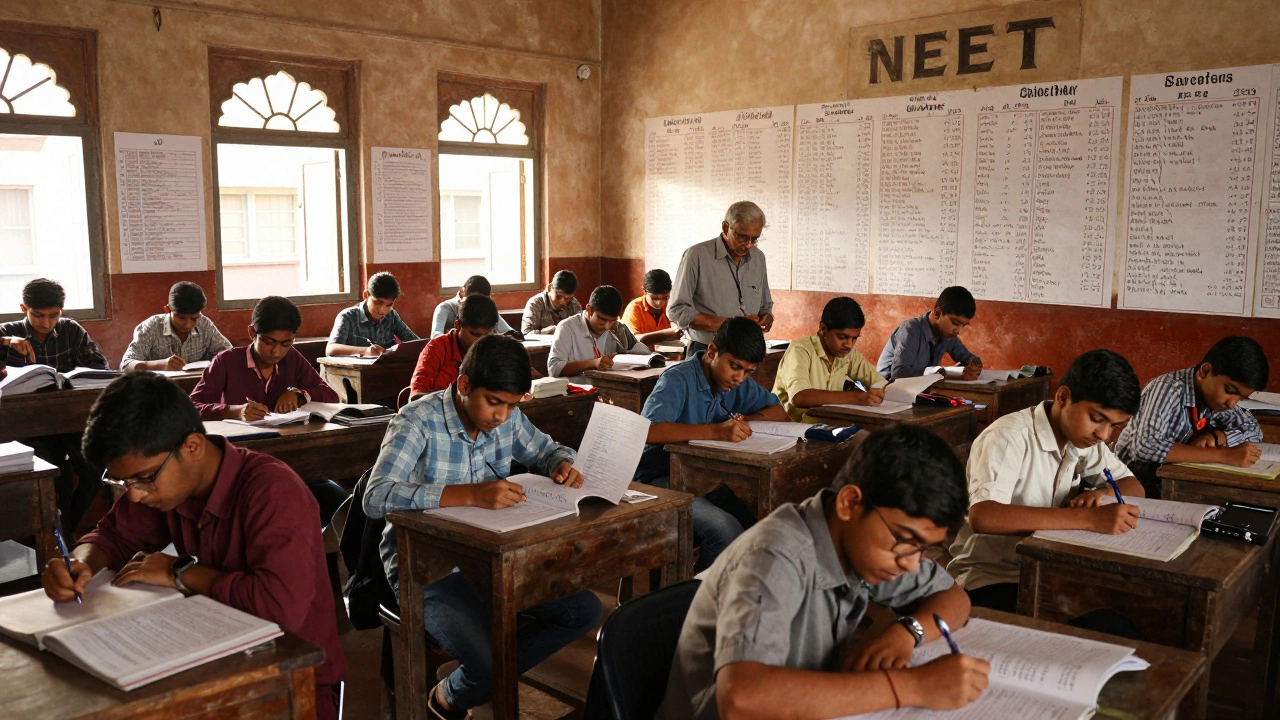
NEET Performance Predictor
How Your System Affects Your NEET Score
Based on the latest NEET trends and state performance data, answer these questions to estimate your potential score range.
Enter your details to see your predicted score range
Every year, lakhs of students across India take the NEET exam - the gateway to medical college admissions. But not all states produce the same number of high scorers. Some states consistently dominate the rankings, while others struggle to keep up. If you're asking which state performs best in NEET, the answer isn’t just about numbers - it’s about culture, coaching systems, and student discipline.
Uttar Pradesh Leads in Total Toppers
When you look at the total number of NEET toppers - students scoring above 700 out of 720 - Uttar Pradesh consistently takes the top spot. In the 2025 exam, over 140 students from UP scored 700+, more than any other state. Why? It’s not luck. It’s a mix of large population, intense competition, and a well-established coaching ecosystem.
Cities like Lucknow, Varanasi, and Agra have dozens of coaching centers that specialize only in NEET. These aren’t just big names - many are family-run institutions that have been training students for three generations. Parents in UP often treat NEET like a family mission. If one sibling didn’t make it, the next one tries harder. The pressure is real, but so is the support.
Tamil Nadu Wins on Consistency and Quality
If Uttar Pradesh leads in quantity, Tamil Nadu leads in quality. While it doesn’t produce as many 700+ scorers as UP, Tamil Nadu has the highest percentage of students clearing NEET with scores above 650. In 2025, nearly 18% of all candidates from TN scored 650+, compared to just 12% in UP.
The secret? Public school systems. Tamil Nadu’s government schools follow a strict science curriculum from Class 6 onward. Biology, Physics, and Chemistry aren’t afterthoughts - they’re core subjects taught with depth. Many students don’t even need private coaching. They rely on school teachers, state-provided study materials, and free online resources from the Tamil Nadu Education Department.
There’s also a cultural emphasis on merit. Winning NEET isn’t seen as a way to get rich - it’s seen as a way to serve. Many top scorers from TN come from middle-class families and openly say they want to work in rural hospitals after graduation.
Delhi’s Edge: Access and Competition
Delhi might be small in area, but its NEET performance is massive. With just 1.9% of India’s population, Delhi produces over 8% of the country’s top 100 NEET rankers. Why? Access.
Delhi has the highest concentration of NEET coaching institutes in India. From Allen and Aakash to smaller local centers, every neighborhood has at least one. Students here don’t just study - they compete daily. Mock tests are weekly. Rank lists are posted publicly. Peer pressure isn’t a buzzword - it’s a daily reality.
Also, Delhi students often have better access to mentors. Many top faculty members from coaching centers in Kota or Hyderabad relocate to Delhi because of better infrastructure. That means students get expert teaching without having to leave home.
Karnataka and Bihar: The Dark Horses
Karnataka - especially Bengaluru - has quietly become a powerhouse. The state has invested heavily in science education in government schools. Many private coaching centers here offer subsidized fees for students from low-income families. In 2025, Karnataka had the second-highest number of students scoring above 680, beating even Maharashtra.
Bihar, on the other hand, is a story of transformation. A decade ago, Bihar had almost no NEET toppers. Today, it’s in the top five. Why? Government scholarships. The Bihar government now gives ₹10,000 per month to NEET aspirants who score above 550 in mock tests. They also run free residential coaching centers in every district. Over 70% of Bihar’s top scorers come from these government programs.
What Makes a State Excel in NEET?
It’s not just about money. It’s about systems. The top-performing states share five key traits:
- Early science focus - Students start studying biology and chemistry before Class 9.
- Strong coaching networks - Affordable, high-quality coaching is widely available, not just in cities.
- Government support - Free study material, scholarships, and residential coaching make a huge difference.
- Cultural pressure - Families treat NEET as a serious life goal, not just an exam.
- Peer competition - Students are constantly benchmarked against peers through mock tests and rank lists.
States that lack one or more of these elements - like West Bengal or Odisha - still have bright students, but they struggle to scale results.

Myth Busting: Is Kota Still the Best?
Many assume Kota, Rajasthan, is the best place for NEET prep. And yes, it’s famous. But here’s the truth: Kota’s dominance is fading. In 2025, only 4 of the top 50 NEET rankers came from Kota. That’s down from 17 in 2020.
Why? Overcrowding. Coaching centers in Kota are packed with 5,000+ students per batch. Many students get lost in the system. Burnout is common. The best students now are choosing local options - coaching centers in their own cities that offer personalized attention.
Today, the real winners aren’t the ones who go to Kota. They’re the ones who find the right system - close to home.
What This Means for Aspirants
If you’re preparing for NEET, don’t assume you need to move to a top-performing state. What matters is the system you’re in.
Are you getting daily practice tests? Do your teachers track your progress? Is there a community of serious aspirants around you? These matter more than whether you live in UP or Punjab.
Even if you’re in a state with low rankings, you can still top NEET. The 2025 NEET topper from Tripura scored 715. She studied from a government school, used free YouTube lectures, and practiced past papers every day. Her secret? Consistency. Not location.
So if you’re wondering which state performs best - focus on the systems, not the state. Build your own system. Stay consistent. And remember: NEET isn’t won by the state with the most toppers. It’s won by the student who shows up every day.
Which state has the highest NEET pass rate?
Tamil Nadu has the highest NEET pass rate, with nearly 85% of its candidates clearing the exam in 2025. This is due to strong government school science programs and low dropout rates. States like Uttar Pradesh and Bihar have higher numbers of toppers but lower overall pass rates because of the massive number of first-time test-takers.
Do coaching centers really make a difference in NEET scores?
Yes - but not all coaching centers are equal. Students who join coaching centers with small batch sizes (under 50 students), regular mock tests, and personalized feedback score 20-30% higher on average than those in large, impersonal centers. The best coaching isn’t about brand names - it’s about how often you’re tested and corrected.
Is it better to study in a top-performing state or stay home?
Staying home is often better - if your local system is strong. Moving to a top-performing state like UP or Delhi can be expensive and stressful. Many students lose motivation when they’re far from family. If your town has a good coaching center or a government-backed program, you’re better off staying. The 2025 topper from Assam studied entirely from her local library and free online resources.
Why do some states have more female NEET toppers?
States like Tamil Nadu, Karnataka, and Kerala have higher numbers of female NEET toppers because of stronger support for girls’ education. In these states, families encourage daughters to pursue medicine as a respected career. In contrast, in states like Uttar Pradesh and Bihar, cultural norms still push girls toward early marriage, reducing the number of female aspirants who reach the exam.
Can a student from a rural area top NEET?
Absolutely. In 2025, 12 of the top 100 NEET rankers came from villages with populations under 5,000. Many used free government digital learning platforms, studied with local teachers, and practiced past papers daily. The key isn’t location - it’s access to consistent practice, feedback, and motivation. Rural students often outperform urban ones because they have fewer distractions and stronger focus.