Coding Path Math Calculator
Select your preferred specialization below to see how much math is actually involved.
Web Development
You’ve probably heard the myth a thousand times. If you want to learn how to code, you need to be a wizard with numbers. People say if you can’t solve quadratic equations in your head, you have no business touching a keyboard. It’s a scary thought, especially if high school algebra left you sweating. But here is the truth: that idea is mostly nonsense. Most of the jobs people do when they write software have almost nothing to do with advanced mathematics.
Think about what coding actually is. It’s not doing calculations. It’s giving instructions. When you write code, you are telling a computer exactly what to do, step by step. If you can follow a recipe to bake a cake or give someone directions to your house, you already have the basic mental muscle needed for programming. The real secret ingredient isn't math; it's logic and problem-solving.
The Difference Between Arithmetic and Logic
To understand why you don't need to be a math genius, we first need to separate two things that get confused all the time: arithmetic and logic. Arithmetic is adding, subtracting, multiplying, and dividing. Logic is understanding cause and effect. Coding relies heavily on the latter.
When you write an if-else statement, which is a fundamental control flow structure in programming that allows code to execute different blocks based on whether a condition is true or false, you aren't doing complex math. You are making a decision. "If the user clicks this button, show the menu. Otherwise, keep it hidden." That is pure logic. It is the same kind of thinking you use when you decide to wear a coat because it is raining outside. You don't need a calculator for that.
Most daily coding tasks involve managing data structures. Imagine you are organizing a library. You need to know where books go, how to find them quickly, and how to add new ones. In programming, these are called arrays, lists, or dictionaries. You might need to know that a list has ten items in it. That is counting. Counting is very basic math, but it is not the kind of heavy lifting that keeps students up at night during calculus exams.
Where Math Actually Matters in Programming
Now, let’s be fair. There are areas of technology where math is king. If your dream is to build the next generation of artificial intelligence models, work on physics engines for video games, or create encryption algorithms for cybersecurity, then yes, you will need strong math skills. Specifically, linear algebra, statistics, and discrete mathematics become essential tools.
However, these fields represent a small slice of the tech industry. For the vast majority of developers-those building websites, mobile apps, internal business tools, and e-commerce platforms-math goes beyond basic addition and subtraction rarely. Even in those specialized fields, you often don't need to derive the formulas yourself. Libraries like TensorFlow or PyTorch handle the heavy mathematical lifting so you can focus on applying the tools.
| Specialization | Math Level Required | Key Concepts Used |
|---|---|---|
| Web Development | Basic (Arithmetic) | Counting, simple percentages, boolean logic |
| Mobile App Development | Basic to Intermediate | Geometry (for layouts), coordinate systems |
| Data Science & AI | Advanced | Statistics, Linear Algebra, Calculus |
| Game Development | Intermediate to Advanced | Trigonometry, Vectors, Physics simulations |
| Cybersecurity | Intermediate | Discrete Math, Number Theory, Cryptography |
The Role of Boolean Logic
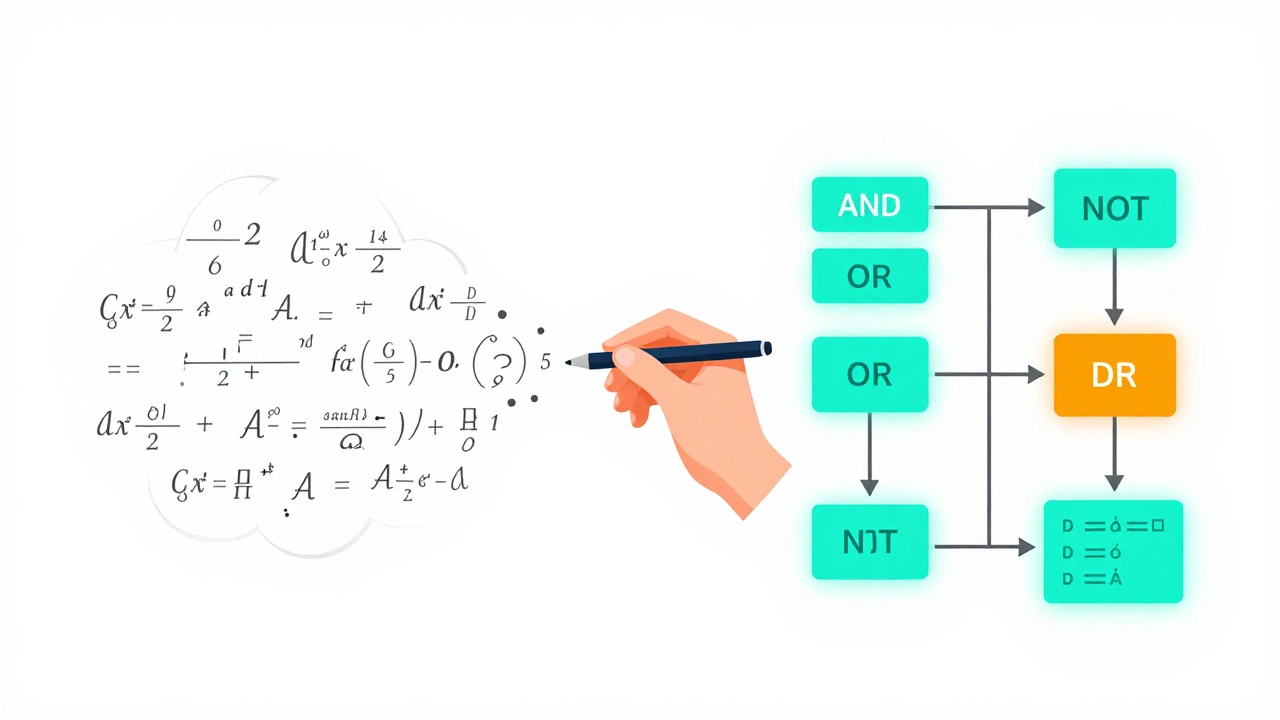
If there is one branch of math that every coder should feel comfortable with, it is Boolean logic. This isn't the kind of math that involves long division. It deals with true and false values. Everything in a computer ultimately boils down to binary: 0s and 1s, off and on, true and false.
Understanding how to combine conditions is crucial. For example, you might want to check if a user is logged in AND if they have admin privileges. Or maybe you want to see if a form field is empty OR if the password is too short. These are logical operations. They are intuitive once you grasp the concept. You use this type of reasoning every day. "I will go for a walk if it is not raining AND I have finished my chores." That is a compound logical statement. Coding just gives it a specific syntax.
This skill is easy to learn and doesn't require a background in higher education. Many beginners find that after a few weeks of practice, thinking in terms of true/false states becomes second nature. It is less about calculation and more about clear, precise thinking.
Problem-Solving Over Calculation
The biggest hurdle for new coders is rarely math. It is breaking down big problems into small steps. This process is called decomposition. Imagine you want to build a website. That is a huge, vague goal. A programmer breaks it down: "First, I need a header. Then, a navigation bar. Then, a main content area." Each of those pieces is smaller and easier to handle.
This ability to chunk information is a cognitive skill, not a mathematical one. It helps in cooking, planning a trip, or organizing a closet. When you code, you are constantly debugging. Debugging means finding out why something didn't work as expected. You look at the steps, trace back where the error happened, and fix it. It is detective work. It requires patience and attention to detail, not the ability to integrate functions.
Many successful developers struggled with math in school. They succeeded in coding because they loved solving puzzles. They enjoyed the satisfaction of making something work from scratch. If you enjoy figuring out how things fit together, you are likely cut out for programming, regardless of your GPA in geometry.
How to Start Without Fear
If you are worried about math holding you back, start with languages that are forgiving and practical. JavaScript, Python, and HTML/CSS are great entry points. These technologies power most of the internet. They focus on functionality and user experience rather than numerical precision.
- HTML and CSS: These are markup and styling languages. There is zero math involved here. You are describing structure and appearance. Colors, fonts, spacing-it is all visual design.
- JavaScript: While it can do math, its primary role in web development is interactivity. Making buttons click, forms submit, and animations play. The logic is straightforward.
- Python: Known for its readability, Python reads like plain English. It is used in everything from web backends to automation scripts. The syntax is clean, allowing you to focus on the logic of the solution rather than complex symbols.
Avoid starting with languages like C++ or Fortran if math anxiety is a concern. These lower-level languages often require manual memory management and stricter type definitions that can feel more abstract and rigid. Stick to high-level languages where the computer handles the messy details for you.
Building Confidence Through Practice
The best way to overcome the fear of math in coding is to simply start coding. Build small projects. Create a personal portfolio site. Make a to-do list app. As you write more code, you will notice that you are rarely reaching for a calculator. You will realize that the "math" you are doing is trivial compared to the creative and logical challenges you are facing.
Join communities. Talk to other beginners. You will quickly discover that most developers Google basic syntax and logic patterns regularly. No one memorizes everything. We rely on documentation and search engines. The value of a modern developer lies in their ability to find solutions and adapt, not in their mental arithmetic speed.
Remember, technology evolves. Tools become easier to use. Frameworks abstract away complexity. The barrier to entry for coding has never been lower. Your potential to contribute to the digital world depends on your curiosity and persistence, not your ability to factor polynomials.
Can I become a software engineer without knowing calculus?
Yes, absolutely. Most software engineering roles, particularly in web development, mobile apps, and enterprise software, do not require calculus. Calculus is primarily needed for roles involving physics simulations, advanced graphics rendering, or machine learning algorithms. For the majority of tech jobs, strong logical thinking and proficiency in programming languages are far more important.
Is algebra necessary for coding?
Basic algebra is helpful but not strictly necessary for many coding paths. Understanding variables (which come from algebra) is fundamental to programming. However, you do not need to solve complex algebraic equations manually. Modern programming languages and libraries handle complex computations automatically. Basic comfort with variables and simple equations is sufficient for most beginners.
What kind of math is used in web development?
Web development primarily uses basic arithmetic and boolean logic. You might calculate percentages for layout widths, determine pixel dimensions, or manage inventory counts in an e-commerce app. Occasionally, you may use simple trigonometry for canvas animations, but this is rare. The focus is on structure, style, and user interaction logic rather than mathematical computation.
Does coding improve math skills?
Coding can improve logical reasoning and problem-solving skills, which are closely related to mathematical thinking. By breaking down complex problems into smaller steps, you develop a structured approach to challenges. While it may not make you better at memorizing formulas, it enhances your ability to think critically and systematically, which benefits overall analytical capabilities.
Which programming language is easiest for non-math people?
Python and JavaScript are widely considered the most beginner-friendly languages for those uncomfortable with math. Python's syntax is clean and readable, resembling plain English. JavaScript is essential for web development and focuses heavily on logic and interactivity rather than numerical complexity. Both have massive communities and resources to help you learn without needing advanced mathematical backgrounds.