
Realistic Coding Learning Timeline Calculator
Your Coding Journey
How long will it take to learn coding based on your goals and commitment?
Your Estimated Timeline
Remember: The key is consistency. Even 1 hour daily adds up over time.
People ask how long it takes to learn to code like it’s a race. You see ads promising "Code in 30 days!" or "Become a developer in 6 weeks!" - but those aren’t real. They’re clickbait. The truth? Learning to code isn’t about speed. It’s about consistency, practice, and understanding what you’re building. If you’re serious about learning, here’s what actually happens - not what the hype sells.
It Depends on What You Want to Do
Not all coding is the same. Want to build a simple website? That’s different from automating spreadsheets, building a mobile app, or working with AI. Your goal changes everything.
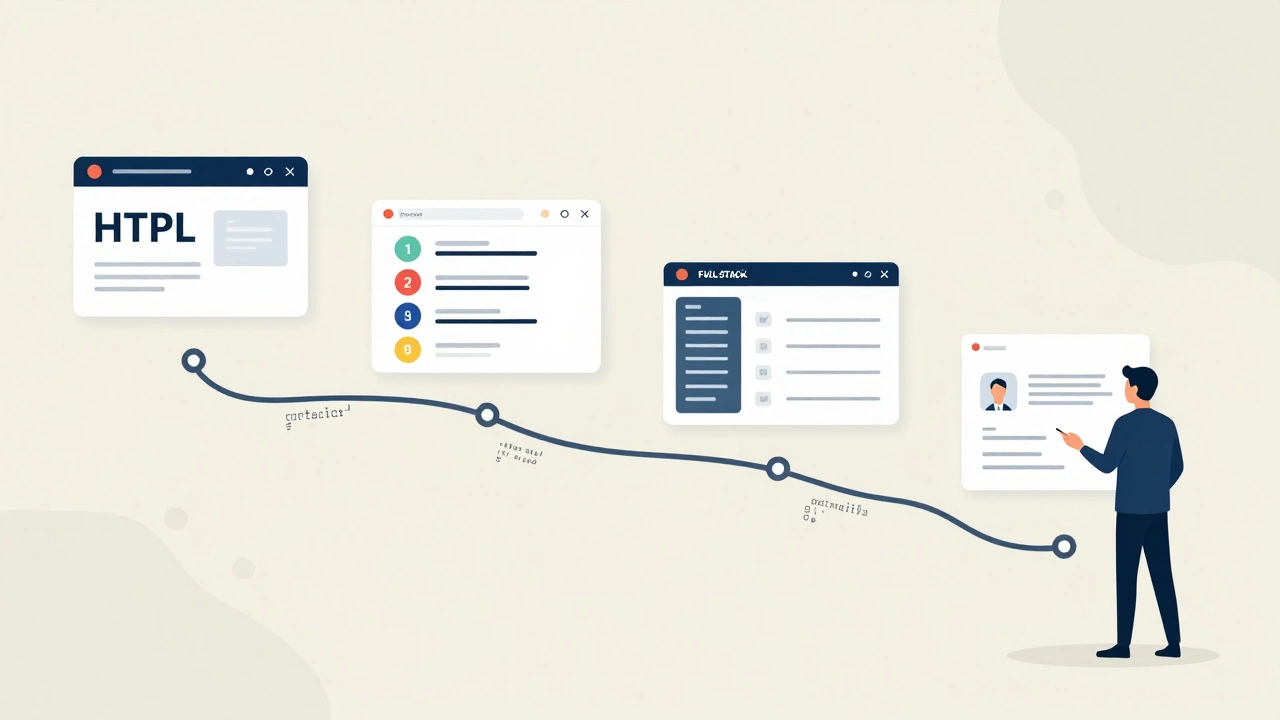
If you want to make a basic website with HTML, CSS, and a little JavaScript - you can get there in 6 to 8 weeks with 10-15 hours a week. You’ll know how to create buttons, style text, and make a page respond to clicks. That’s enough to land a freelance gig for small business sites or update your own portfolio.
But if you want to build a full-stack app - something with a database, user login, API calls, and server logic - that’s a different story. It takes 6 to 9 months of steady learning. You’ll need to understand front-end (React or Vue), back-end (Node.js or Python), databases (PostgreSQL or MongoDB), and how they all talk to each other. That’s not something you pick up in a weekend.
And if you’re aiming for a job at a tech company? That’s usually 12 to 18 months. You’ll need to solve algorithm problems, understand data structures, and build projects that show you can think like a developer - not just copy tutorials.
Most People Give Up Before They Get Started
The biggest barrier isn’t difficulty. It’s frustration. You watch a video. You follow along. Everything works. Then you close the tab and try it yourself - and nothing works. The error message is in Spanish. The code doesn’t match the tutorial. You feel stupid.
That’s normal. Every developer has been there. The difference between those who make it and those who quit? They keep going even when it’s confusing.
Here’s what works: start small. Build one thing. A to-do list app. A weather checker. A calculator. Don’t jump into building Instagram. Build a tiny project, then make it better. Add a feature. Fix a bug. Do it again. That’s how skills stick.
One person I know in Sydney learned to code while working night shifts. He spent 30 minutes a day on freeCodeCamp. Six months later, he built a simple app for his local community center to track volunteer hours. He didn’t become a senior engineer. But he got hired as a junior dev because he had something real to show - not just certificates.
Learning to Code Isn’t Like Learning a Language
People say coding is like learning Spanish. It’s not. You don’t memorize vocabulary and conjugate verbs. Coding is about problem-solving with logic. You’re learning how to break big problems into tiny steps and tell a computer exactly what to do.
Think of it like cooking. Watching a chef on TV doesn’t make you a cook. You have to chop onions, burn toast, over-salt soup, and try again. Coding is the same. You’ll write code that crashes. You’ll delete 200 lines because one semicolon was missing. That’s not failure - that’s the process.
The best learners don’t memorize syntax. They learn how to read documentation. They learn how to Google errors. They learn how to ask for help without sounding lost. That’s the real skill.
What You Need to Succeed
You don’t need a degree. You don’t need to be good at math. You don’t need to be a genius. You just need three things:
- Time - Even 1 hour a day, 5 days a week, adds up. That’s 5 hours a week. In 6 months, that’s 120 hours. That’s enough to build something real.
- Consistency - Skip a day? Fine. Skip a week? You’ll forget. Keep showing up, even if it’s just to fix one line of code.
- A project - Learn by doing. Not by watching. Not by reading. By building something that matters to you.
Use free tools: freeCodeCamp, The Odin Project, or CS50 from Harvard. They’re not flashy. They don’t promise miracles. But they work. One person in Melbourne spent 8 months on The Odin Project, built a job board app, and got hired without a resume - just a GitHub link.
Realistic Timelines Based on Your Goal
Here’s what most people actually achieve with consistent effort:
| Goal | Time Required | Hours per Week | What You’ll Build |
|---|---|---|---|
| Basic website (HTML/CSS/JS) | 6-8 weeks | 10-15 | Personal portfolio, small business landing page |
| Simple app (e.g., to-do list, calculator) | 3-4 months | 8-12 | Front-end app with user interaction |
| Full-stack web app | 6-9 months | 12-15 | App with login, database, and API |
| Job-ready developer | 12-18 months | 15-20 | 3-5 portfolio projects, GitHub profile, interview skills |
Notice something? No one learns to code in 30 days. But everyone can learn enough in 3 months to do something useful. And that’s where most people stop - and that’s okay.
What Most Courses Don’t Tell You
Bootcamps promise jobs. They often don’t deliver. Many grads end up doing freelance work or entry-level support roles - not software engineering. Why? Because they learned syntax, not problem-solving.
The best coding classes don’t teach you how to write code. They teach you how to think like a developer. That means:
- Reading error messages instead of panicking
- Breaking problems into smaller parts
- Testing one thing at a time
- Asking for help the right way (show your code, explain what you tried)
That’s what employers care about. Not how many courses you took. Not how many certificates you have. It’s whether you can solve a real problem - even if you don’t know the answer right away.
You Don’t Need to Be Perfect
I’ve seen people quit because they thought they had to write clean, perfect code on day one. They didn’t. No one does. Even senior devs write messy code sometimes. The difference? They know how to fix it.
Code doesn’t have to be elegant. It just has to work. Then you make it better. That’s the cycle: write → break → fix → improve. Repeat.
One developer I know wrote his first app in 2019. It crashed every time someone clicked a button. He kept it. He showed it to interviewers. He said, "This was my first project. Here’s what I learned from it." He got the job.
Where to Start Today
If you’re reading this and thinking, "I want to try," here’s your first step:
- Pick one thing you want to build. Something small. Something you care about.
- Go to freeCodeCamp.org and do the Responsive Web Design certification. It’s free. Takes 30 hours.
- Build it. Don’t copy. Type everything yourself.
- When it breaks, Google the error. Don’t quit.
- Do this for 30 days. Then check back.
You won’t be a developer in 30 days. But you’ll know more than 90% of the people who started and gave up.
Can I learn to code at 30, 40, or 50?
Absolutely. Age doesn’t matter. What matters is persistence. Many people start coding later in life - after careers in nursing, teaching, or trades. They bring different skills: patience, communication, problem-solving. Those are just as valuable as technical knowledge. The tech industry needs people who can think clearly, not just people who memorized syntax.
Do I need a computer science degree?
No. Most developers today don’t have one. Companies care more about what you can build than what’s on your diploma. You can learn everything you need through free resources, projects, and practice. A degree helps if you want to work at big tech firms like Google or Meta - but even there, portfolios and coding tests matter more than the degree itself.
Is Python the best language to start with?
Python is a great choice for beginners because it’s readable and used in web development, data, and automation. But it’s not the only option. JavaScript is better if you want to build websites. HTML and CSS are the foundation of all web work. Start with what you want to build - not what’s trendy. If you want to make apps for phones, learn React Native. If you want to automate tasks, learn Python. If you want to build websites, start with HTML, CSS, then JavaScript.
How much time should I spend coding each day?
1 hour a day is enough - if you’re consistent. Two hours is better. But 5 hours once a week won’t help as much. Coding is a skill that grows with repetition. Think of it like playing guitar. Practicing 15 minutes every day builds muscle memory. Cramming on weekends doesn’t. Focus on daily habits, not marathon sessions.
What if I get stuck and can’t solve a problem?
Everyone gets stuck. The key is knowing how to get unstuck. First, read the error message carefully - it often tells you exactly what’s wrong. Second, search the exact error on Google. Stack Overflow has answers for 90% of beginner problems. Third, break the problem into smaller pieces. Can you make just one part work? Then add the next. If you’re still stuck, ask for help on a forum - but show your code and what you’ve tried. People are more willing to help if you show effort.
Will I be able to get a job after learning to code?
Yes - but not just because you learned code. You need to show you can solve real problems. Build 3 solid projects. Put them on GitHub. Write clear README files explaining what they do. Learn how to talk about them in interviews. Many entry-level jobs don’t require years of experience - they just want someone who can learn fast and doesn’t quit when things get hard. That’s you, if you stick with it.
Final Thought: It’s a Marathon, Not a Sprint
You don’t need to learn everything at once. You just need to keep going. Every line of code you write - even the broken ones - makes you better. The people who succeed aren’t the smartest. They’re the ones who showed up when it was hard.
Start small. Build something. Break it. Fix it. Do it again. That’s how you learn to code - not from a course, but from doing.