Daily Fluency Practice Tracker
Practice Journal
Why this matters
Consistent practice builds fluency. Just 10 minutes daily creates momentum. The article shows that people who practice daily for 30 minutes/week see results in 3-6 months.
Want to speak English without pausing, second-guessing every word, or feeling embarrassed when someone asks you a simple question? You’re not alone. Millions of people around the world-students, professionals, immigrants-struggle with the same thing. Fluency isn’t about knowing every word. It’s about being able to say what you mean, when you mean it, without freezing up.
Stop memorizing scripts. Start thinking in English.
Most people try to learn English by memorizing phrases like "Could you please pass the salt?" or "I would like to book a flight." That’s fine for polite moments. But real conversation doesn’t work like a script. When you’re stuck, you don’t recall memorized lines-you panic. The fix? Start thinking in English. Not translating from your native language. Think about what you want to say in English, even if it’s just in your head. When you’re making coffee, think: "I need more sugar." When you’re waiting for the bus, think: "This bus is late again." It sounds small, but this habit rewires your brain. A 2023 study from the University of Sydney found that learners who practiced internal monologue in English for just 10 minutes a day showed 37% faster response times in real conversations after six weeks. You’re not learning phrases-you’re building a new mental language layer.Speak out loud-even if you’re alone.
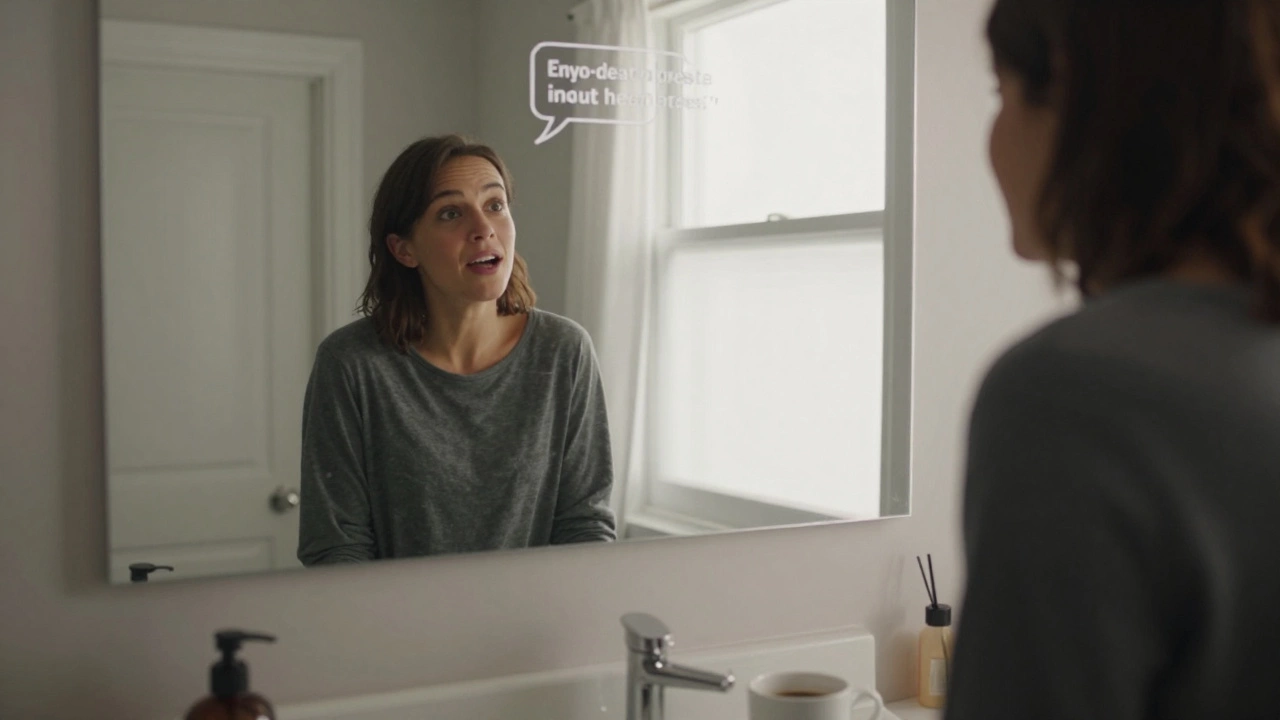
You wouldn’t learn to ride a bike by only watching videos. Same with speaking. You need to use your mouth, your tongue, your breath. Silence doesn’t build fluency. Sound does. Try this: Every morning, spend five minutes talking to yourself in the mirror. Describe your day. Comment on the weather. Tell yourself why you’re making toast instead of cereal. Don’t worry about grammar. Don’t worry if you sound silly. Just speak. Record yourself once a week. Listen back. You’ll notice the filler words-"um," "uh," "like"-that slow you down. You’ll also hear progress. That shaky voice you hated last week? It’s stronger now.Listen like you’re learning to dance.
You don’t learn to dance by reading a manual. You learn by watching, moving, copying. English is the same. Don’t just listen to podcasts while doing chores. Listen actively. Pick a short clip-30 seconds-from a YouTube video or Netflix show. Play it once to understand the meaning. Play it again and mimic the rhythm. Copy the pauses. Copy the way the speaker raises their voice at the end of a question. Do this for three days with the same clip. You’ll start noticing how native speakers link words: "wanna" instead of "want to," "gonna" instead of "going to." These aren’t slang-they’re how English flows in real life. Learning them makes you sound natural, not textbook.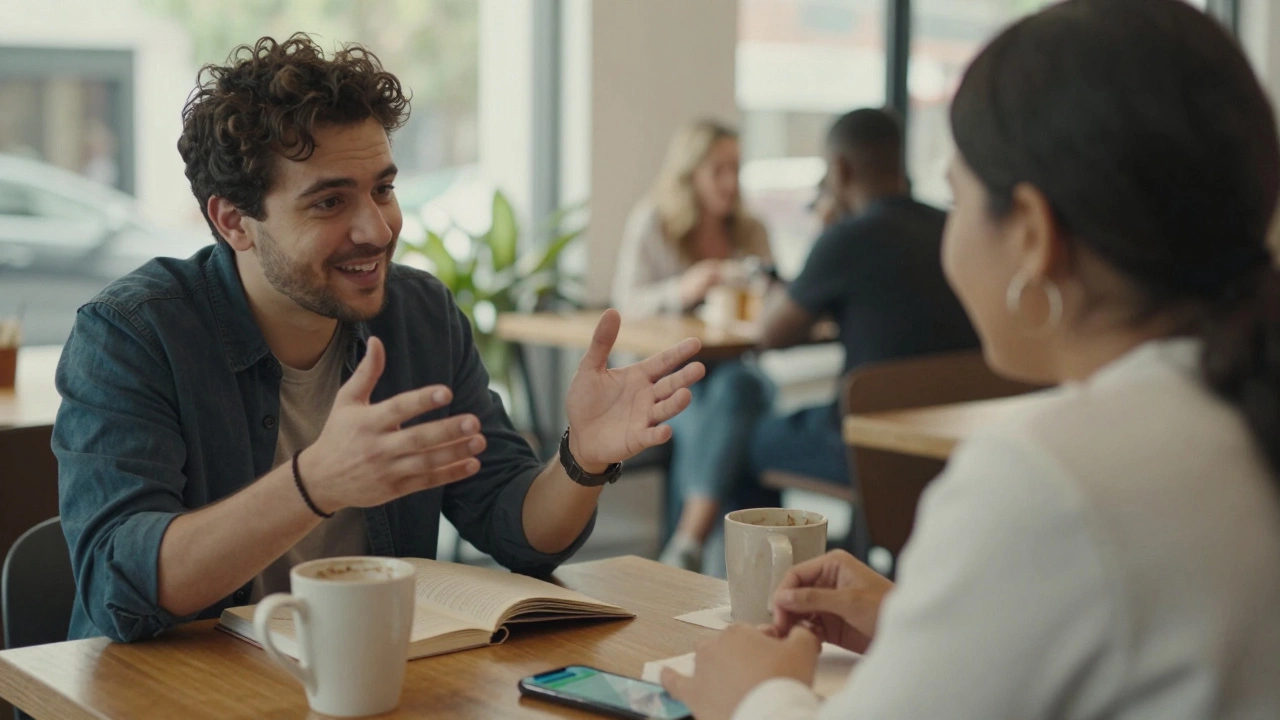
Find your 10-minute conversation partner.
You don’t need a tutor. You don’t need to fly to London. You need one person who will talk to you-even if they’re not perfect. Look for local language exchange meetups. In Sydney, places like The Language Exchange in Newtown or online groups on Meetup.com connect people who want to practice English and other languages. You help someone with your native language. They help you with English. No pressure. No grades. Just talk. If you can’t find someone locally, use apps like Tandem or HelloTalk. Filter for people who want to practice English and are willing to do 10-minute voice calls. Set a timer. Talk about your favorite food. Your last vacation. Your pet. Anything. The goal isn’t to be perfect. It’s to get used to speaking without fear.Embrace mistakes. They’re data, not failures.
You said "I goed to the store"? Good. That’s not a mistake-it’s feedback. Your brain is trying to apply a rule (add -ed for past tense) but hasn’t yet learned the exception. That’s normal. Instead of cringing, write it down. Keep a "mistake journal." Every time you say something wrong, note it. Next time you hear the correct version, compare. "I went to the store"-got it. Now you’ve turned a slip into a lesson. People who improve fastest aren’t the ones who never mess up. They’re the ones who keep talking after they mess up. Confidence doesn’t come from being perfect. It comes from knowing you can recover.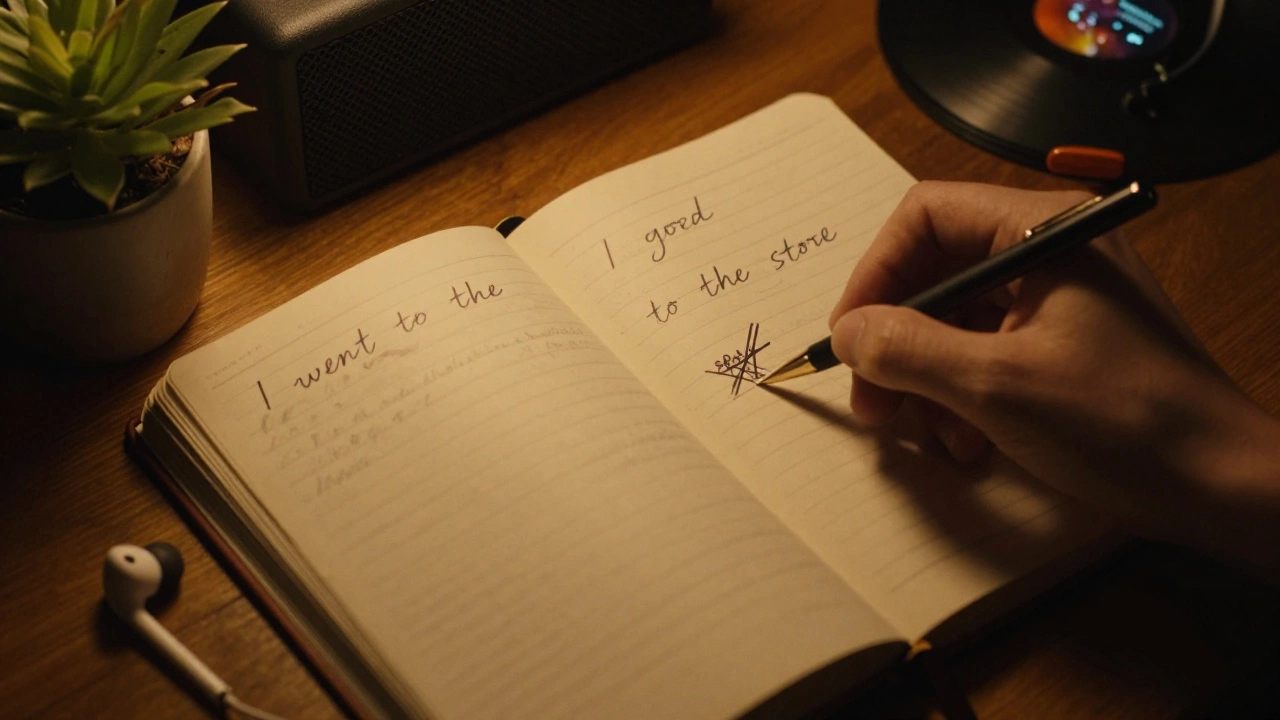
Build your own "go-to" phrases for real situations.
You don’t need to know 10,000 words. You need 50 that work in 90% of conversations. Here are 10 phrases that open doors:- "What do you mean by...?" (to ask for clarification)
- "Can you repeat that, please?" (to buy time)
- "I’m not sure, but I think..." (to express uncertainty without panic)
- "That’s interesting-how did that happen?" (to keep a conversation going)
- "I’m still learning, so please correct me." (to invite help)
- "Let me think for a second." (to pause without silence)
- "In my country, we usually..." (to share your perspective)
- "Could you say that slower?" (to slow things down)
- "I agree with you because..." (to join a discussion)
- "Thanks for explaining that." (to end on a positive note)
Change your environment, change your mindset.
Your phone, your TV, your music-make them English-only for a week. Set your phone language to English. Watch your favorite shows with English subtitles (not your native language). Listen to English music and try to sing along. Why? Because your brain learns from repetition. The more English you’re exposed to, the more it becomes background noise you understand without thinking. Also, change your inner dialogue. Instead of thinking, "I’m bad at English," say, "I’m learning English." Small shift. Big difference. Language isn’t a test. It’s a skill-and skills get better with practice, not talent.Fluency isn’t a destination. It’s a habit.
There’s no magic course. No app that will suddenly make you fluent. Fluency comes from doing a little, every day. Ten minutes of speaking. Five minutes of listening. One mistake written down. That’s it. Most people quit because they expect big results fast. But fluency grows slowly-like a plant. You don’t see it changing day to day. But after a month? You’ll notice you’re not afraid to speak. After three months? You’re starting to dream in English. Start today. Not tomorrow. Not next week. Today. Say one thing out loud in English. Even if it’s just "I’m going to speak better." You already have what you need: your voice, your time, and the willingness to try.How long does it take to speak English fluently?
There’s no fixed timeline-it depends on how much you practice. Someone who speaks English for 30 minutes a day, five days a week, usually sees clear improvement in 3 to 6 months. Fluency isn’t about speed. It’s about consistency. People who practice daily, even for just 10 minutes, often outperform those who study for hours once a week.
Do I need to take an English course to become fluent?
No. Many people become fluent without formal courses. What matters is active speaking practice, not classroom lessons. Courses can help with structure, but if you’re not speaking regularly, you won’t improve. Focus on real conversations, listening, and self-talk first. Use courses only if they give you tools to speak more-not just to memorize grammar.
Why do I feel nervous speaking English even when I know the words?
Nervousness comes from fear of judgment, not lack of knowledge. Your brain is wired to avoid embarrassment. The fix? Reduce the stakes. Practice with people who won’t judge you-like language partners or even your pet. The more you speak without fear of mistakes, the less power fear has. Over time, your confidence grows because you prove to yourself that speaking won’t break you.
Is it okay to mix my native language with English?
Yes, especially when you’re starting. Many bilingual speakers naturally mix languages-it’s called code-switching. Don’t see it as a weakness. It’s a sign your brain is working. As you get more comfortable, you’ll naturally use less of your native language. But forcing yourself to speak only English too soon can make you anxious. Let it happen gradually.
What if no one around me speaks English?
You don’t need people around you to speak English-you need to create opportunities. Use apps like Tandem, join online conversation clubs, or watch YouTube videos and repeat what you hear out loud. Even talking to yourself counts. The key is to make speaking a habit, not a special event. Start small: describe your breakfast in English. That’s a conversation.
Can I become fluent just by watching movies and TV shows?
Watching helps with listening and vocabulary, but not with speaking. You can understand everything on screen and still freeze when someone asks you a question. To speak fluently, you must speak. Combine watching with active practice: pause and repeat lines, shadow the speaker, or summarize what happened in your own words. Passive input supports active output-but it doesn’t replace it.