IIT JEE Preparation Timeline Estimator
Assess Your Situation
Based on your inputs, here is the recommended strategy to maximize your rank potential.
Recommended Timeline
--Strategy details will appear here.
Risk Assessment
Key Focus Area
--
Action Items
Imagine staring at a mountain so high you can’t see the peak. That’s what IIT JEE looks like to most students in Class 11. It is not just an exam; it is a rite of passage that filters millions into a few thousand seats at India's top engineering institutes. The biggest question haunting every aspirant isn't "Can I crack it?" but rather "How much time do I actually need to prepare?" There is no single magic number, but there is a realistic roadmap based on data from successful candidates and coaching institute trends.
You might have heard stories of students cracking JEE Advanced with six months of intense study or others struggling after three years. The truth lies somewhere in between, heavily dependent on your starting point, your school curriculum, and your daily efficiency. This guide breaks down the timeline, helping you decide whether two years, one year, or even six months will suffice for your specific situation.
The Two-Year Standard: Why Class 11 Matters Most
Most experts agree that the ideal window for IIT JEE preparation begins when you enter Class 11. This gives you approximately 24 months. Why so long? Because the syllabus is vast. It covers Physics, Chemistry, and Mathematics across both Class 11 and Class 12 curricula, plus additional topics tested only in JEE. Starting early allows you to build a conceptual foundation rather than just memorizing formulas.
In Class 11, you aren't just learning new chapters; you are unlearning how you studied in middle school. School exams often reward rote learning. JEE rewards application. If you wait until Class 12 to start serious prep, you are playing catch-up while also managing board exams. Students who begin in April of Class 11 typically score higher because they have time to make mistakes, analyze them, and correct course without the panic of imminent finals.
| Phase | Daily Self-Study (Hours) | Primary Focus | Risk Level |
|---|---|---|---|
| Class 11 (First Half) | 3-4 | Concept Building & Basics | Low |
| Class 11 (Second Half) | 4-5 | Advanced Problems & Speed | Medium |
| Class 12 (First Half) | 5-6 | New Topics + Revision of Class 11 | High |
| Class 12 (Final Months) | 8-10 | Mock Tests & Full Syllabus Revision | Critical |
The One-Year Sprint: Is It Possible?
What if you missed the boat in Class 11? Can you still crack JEE Main in one year? Absolutely. Thousands of students do this every year, especially those switching from state boards to CBSE/ICSE patterns or those who realized their potential late. However, the intensity changes drastically.
A one-year plan requires treating preparation as a full-time job alongside school. You cannot afford gaps. Your weekends must be dedicated entirely to problem-solving. The key here is prioritization. You cannot cover every obscure topic with equal depth. You need to identify high-weightage areas in Physics, Chemistry, and Math. For instance, Organic Chemistry and Calculus are consistent scorers. Neglecting them for low-yield topics is a fatal error.
Students attempting this route often join intensive crash courses or rely heavily on self-study with rigorous mock test schedules. The psychological pressure is higher because there is less room for error. If you fall behind in October, catching up in January becomes exponentially harder. Discipline beats motivation here. Motivation fades; discipline keeps you studying when you don't feel like it.
The Six-Month Miracle: Droppers and Last-Minute Pushes
Then there are the "droppers"-students who take a gap year after Class 12 to focus solely on JEE. For them, six months of focused effort is common. But let’s be clear: six months is not enough if you are starting from zero. It works best if you already have a decent grasp of the basics from your first attempt.
For droppers, the strategy shifts from learning to mastering. You aren't reading textbooks cover-to-cover anymore. You are solving previous year questions (PYQs) from the last 10-15 years. You are analyzing your weak links through diagnostic tests. If you score below 50% in your first mock test, six months might be tight unless you increase your study hours to 10-12 per day. This phase is brutal on mental health, so sleep and nutrition become part of your study plan, not distractions from it.
Quality Over Quantity: The Myth of 12-Hour Days
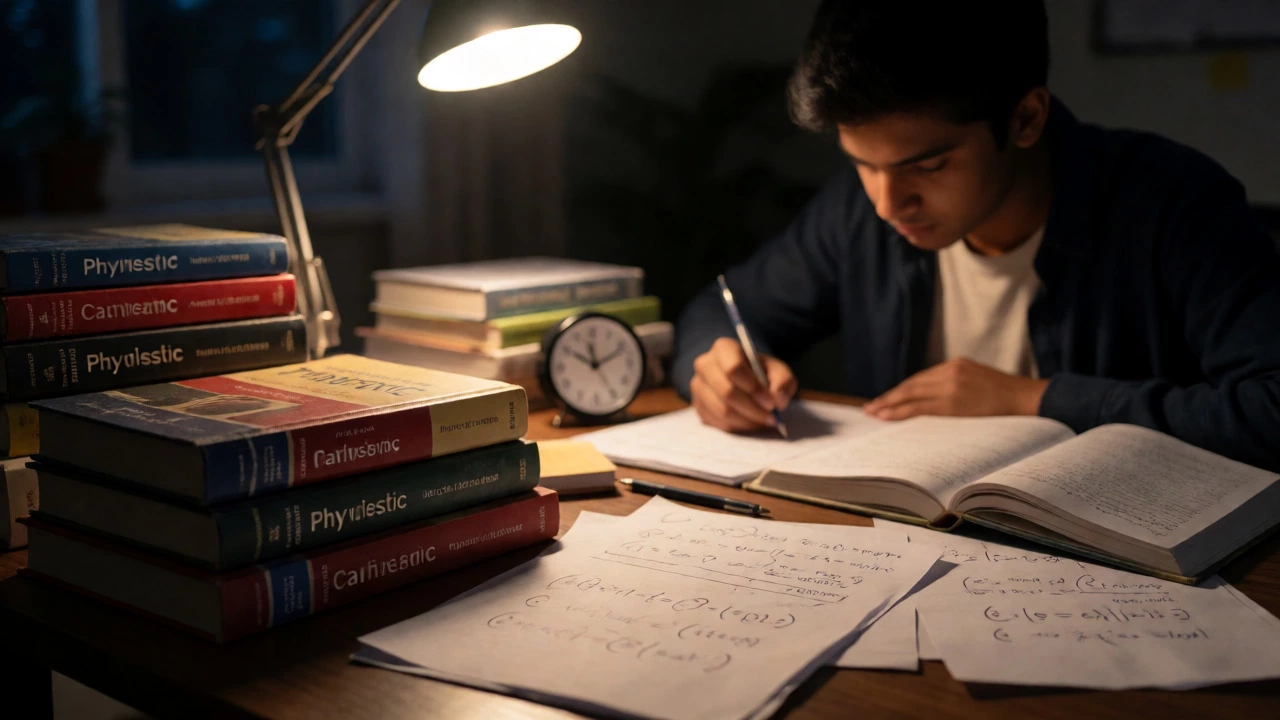
You’ve probably seen influencers bragging about studying 14 hours a day. Don't buy into the hype blindly. Studying for 12 hours with a wandering mind is worse than studying for 6 hours with deep focus. The brain has limits. After about 90 minutes of intense cognitive work, retention drops significantly unless you take a break.
Effective preparation involves active recall and spaced repetition. Sitting with a book open for five hours doesn't mean you learned anything. Did you solve problems? Did you explain concepts aloud? Did you review errors? A student studying 5 hours effectively will outperform one studying 10 hours passively. Track your output, not just your input. Count the number of quality problems solved, not the hours logged.
Balancing Boards and Entrance Exams
A major stressor is the conflict between CBSE Board Exams and JEE. Many students panic, thinking they need separate preparation. Here is a secret: the core syllabus is identical. The difference is in the depth and type of questions. Board exams ask direct theory and standard numericals. JEE asks multi-concept applications.
If you prepare well for JEE, you automatically cover 80% of the board requirements. The remaining 20%-like writing long answers or diagram labeling-takes minimal time before boards. Do not sacrifice JEE prep for board perfection. A 95% vs. 98% in boards makes little difference in admission, but a rank of 500 vs. 50,000 in JEE changes your entire career trajectory.

Key Factors Influencing Your Timeline
Your required time depends on several variables. Be honest with yourself about these:
- Current Proficiency: Are you strong in Math but weak in Physics? You’ll need more time for Physics.
- School Type: International Baccalaureate (IB) or State Board students may need extra time to adapt to the CBSE/JEE pattern compared to CBSE students.
- Coaching Support: Structured coaching saves time on planning but takes time to attend. Self-study requires better organizational skills.
- Mental Stamina: Can you sit for 3 hours straight? If not, building this endurance takes weeks.
Practical Steps to Start Today
Regardless of your timeline, action beats planning. Here is a quick checklist to kickstart your journey:
- Gather Resources: Stick to NCERT for Chemistry and basic Physics. Use reference books like HC Verma for Physics and Cengage for Math later.
- Set Daily Goals: Not "study Physics," but "solve 10 kinematics problems."
- Analyze PYQs: Download the last 5 years' JEE Main papers. Look at the trend. See which chapters appear most frequently.
- Take a Baseline Test: Attempt a full-length mock under timed conditions. Score it honestly. This shows your real starting line.
Remember, consistency compounds. Studying 4 hours every day for two years yields better results than cramming 12 hours a day for two months. The marathon runner always beats the sprinter in the long run.
Is 1 year enough for IIT JEE preparation?
Yes, 1 year is sufficient if you are disciplined and have a good grasp of Class 11 basics. It requires 6-8 hours of daily study and strict adherence to a schedule. However, starting from scratch in 1 year is challenging and requires intense focus on high-weightage topics.
How many hours should I study daily for JEE?
For Class 11 students, 3-5 hours of self-study outside coaching/school is ideal. For Class 12 students, aim for 6-8 hours. Droppers should target 8-10 hours. Quality matters more than quantity; ensure these hours are focused and free from distractions.
Can I crack JEE without coaching?
Absolutely. Many top rankers are self-taught. Success depends on access to good resources (books, online lectures), self-discipline, and regular testing. Coaching provides structure and peer competition, which some students find helpful, but it is not mandatory.
Which subject takes the most time in JEE?
Mathematics generally consumes the most time due to its complexity and volume of practice needed. Physics requires significant conceptual clarity. Chemistry is often considered the scoring subject but requires thorough memorization of facts and reactions, especially in Inorganic Chemistry.
Is it too late to start JEE prep in Class 12?
It is late but not impossible. You must prioritize smartly. Focus on completing the syllabus quickly and then dedicate maximum time to revision and mock tests. Expect a steeper learning curve and higher stress levels compared to those who started in Class 11.