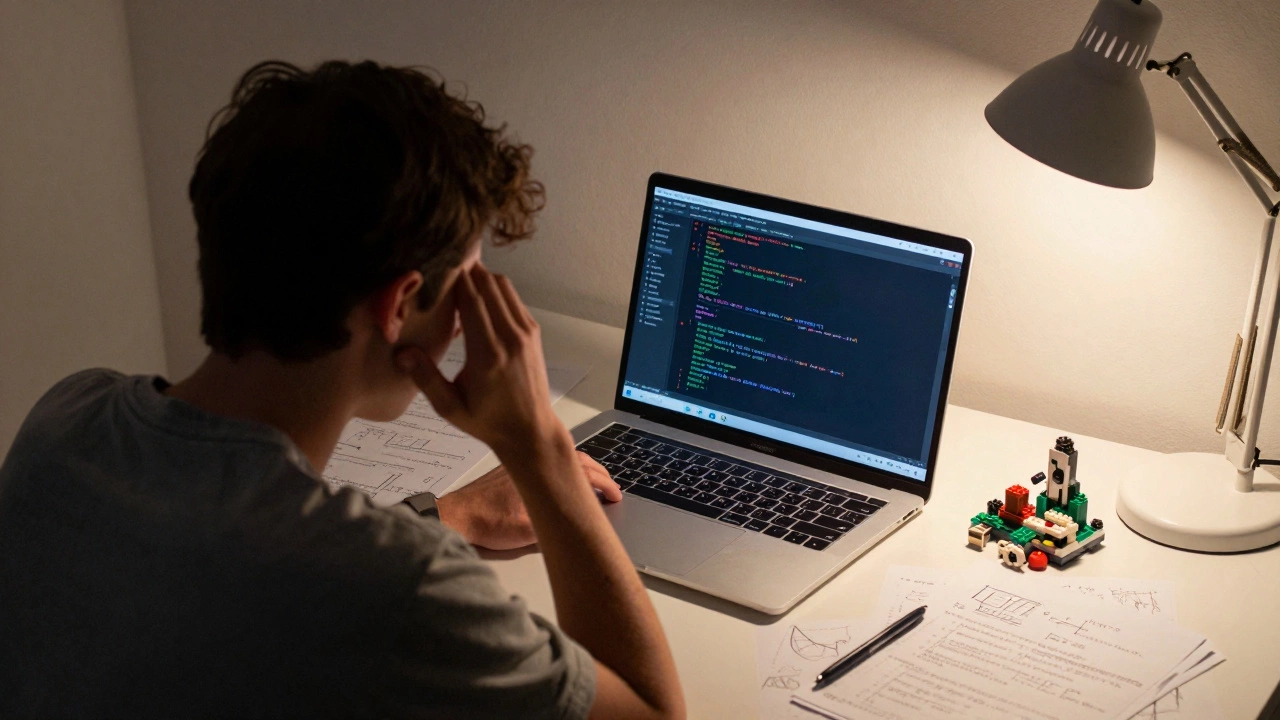
Ever sat down to solve a math problem and thought, "This is harder than writing code"? Or stared at a line of Python and wondered if math would’ve been easier? You’re not alone. People across the world-students, career switchers, self-taught devs-keep asking: coding or math, which one’s truly harder?
The truth? Neither is harder. But they’re harder in completely different ways. You don’t get better at coding by memorizing formulas. And you don’t fix a broken app by solving an equation. They demand different kinds of thinking. And that’s where the confusion starts.
Coding Is About Building, Not Solving
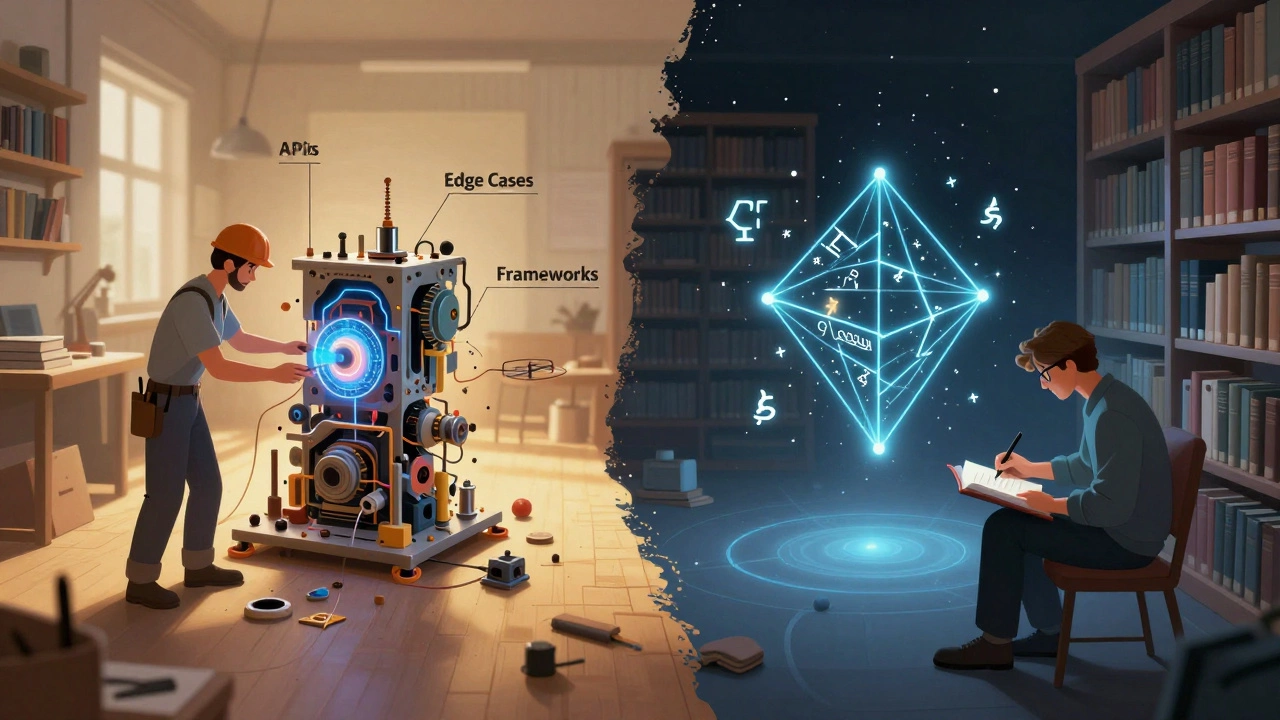
Coding isn’t math with parentheses. It’s construction. You’re not finding a single right answer-you’re building something that works under messy, unpredictable conditions. Think of it like assembling a piece of IKEA furniture… but the instructions are written in a language you’re still learning, half the parts are missing, and the whole thing has to run on a computer that changes its mind every few hours.
Real-world coding means dealing with:
- APIs that return weird data formats
- Edge cases you never thought of (like users typing "12/31/1999" in a date field)
- Debugging something that works on your machine but crashes on the server
- Frameworks that update overnight and break your code
There’s no textbook answer. You Google, you test, you guess, you fail, you try again. It’s messy. It’s repetitive. And it takes patience you didn’t know you needed.
Meanwhile, math gives you a clear path: if you follow the rules, you get the right answer. But the rules? They can be brutal. A single misstep in a 10-step proof means you’re back to square one. No partial credit. No "it works on my machine."
Math Is About Precision, Not Persistence
Math is unforgiving. One wrong sign. One skipped step. One misremembered theorem. And your entire solution collapses. There’s no "close enough." In calculus, if you forget to multiply by 2, you don’t get 90%. You get 0%. No mercy.
And the abstraction? It’s real. You’re not building a button that says "Submit." You’re working with infinite series, non-Euclidean geometry, or abstract algebra-concepts that have no physical form. You can’t touch them. You can’t see them. You have to imagine them.
Take linear algebra. You’re not just moving numbers around. You’re visualizing vectors in 17-dimensional space. No one’s ever seen 17D space. But you have to reason about it. That’s not logic. That’s mental gymnastics.
And then there’s proof-based math. You don’t just solve an equation. You have to convince someone, step by step, that your answer is the only possible one. It’s like writing a legal argument, but with symbols instead of words.
Why People Think Math Is Harder
Most people’s first exposure to math is in school: timed tests, memorizing formulas, being graded on accuracy. It feels like a race against time and error. Coding? At first, it looks like magic. You type a few lines and a website pops up. It feels easy.
But that’s the trap. Early coding feels like playing with LEGO. You follow a tutorial, copy-paste, and boom-you’ve built something. But that’s not coding. That’s following a recipe. Real coding starts when the recipe breaks. When the server crashes. When the user inputs "<script>alert('hacked')</script>" into your form. That’s when you realize: you’re not just writing code. You’re anticipating chaos.
Math doesn’t give you that false sense of safety. You know from day one that you’re dealing with something that doesn’t care if you’re tired, distracted, or rushed. It’s pure, silent, and exact.
Why People Think Coding Is Harder
Coding has no fixed rules. Math has axioms. Coding has libraries. Math has theorems. But libraries change. Frameworks die. Python 3.12 breaks code that worked in 3.10. Math? The Pythagorean theorem hasn’t changed since 500 BCE.
Coding demands constant learning. Every six months, a new tool emerges. A new best practice. A new way to do the same thing. You have to stay updated. Or you become obsolete. Math? Once you master calculus, you’ve got it for life. You don’t need to relearn integration in 2026.
And then there’s the emotional toll. A math problem might take two hours. A coding bug? It can take two days. And you’ll spend 18 of those hours staring at the same line, wondering why it’s not working. You’ll feel stupid. You’ll doubt yourself. You’ll wonder if you’re cut out for this.
That’s the hidden cost of coding: it’s not just hard. It’s lonely. Math problems can be solved with a textbook. Coding problems? You’re often alone with a Stack Overflow thread from 2013.
Who Finds Each Harder?
There’s no universal answer. It depends on your brain.
If you’re naturally good at pattern recognition, logic puzzles, and visualizing systems-you’ll probably find coding easier. Think of it like chess. You see moves ahead. You anticipate failures. You enjoy the process of building something that adapts.
If you’re wired for precision, structure, and abstract reasoning-you’ll likely thrive in math. You don’t mind spending hours on one proof. You like the elegance of a clean solution. You don’t need external validation. The logic itself is enough.
But here’s the twist: most people who struggle with coding think they’re bad at math. And most who struggle with math think they’re bad at logic. They’re not. They’re just using the wrong kind of thinking.
Real-World Examples
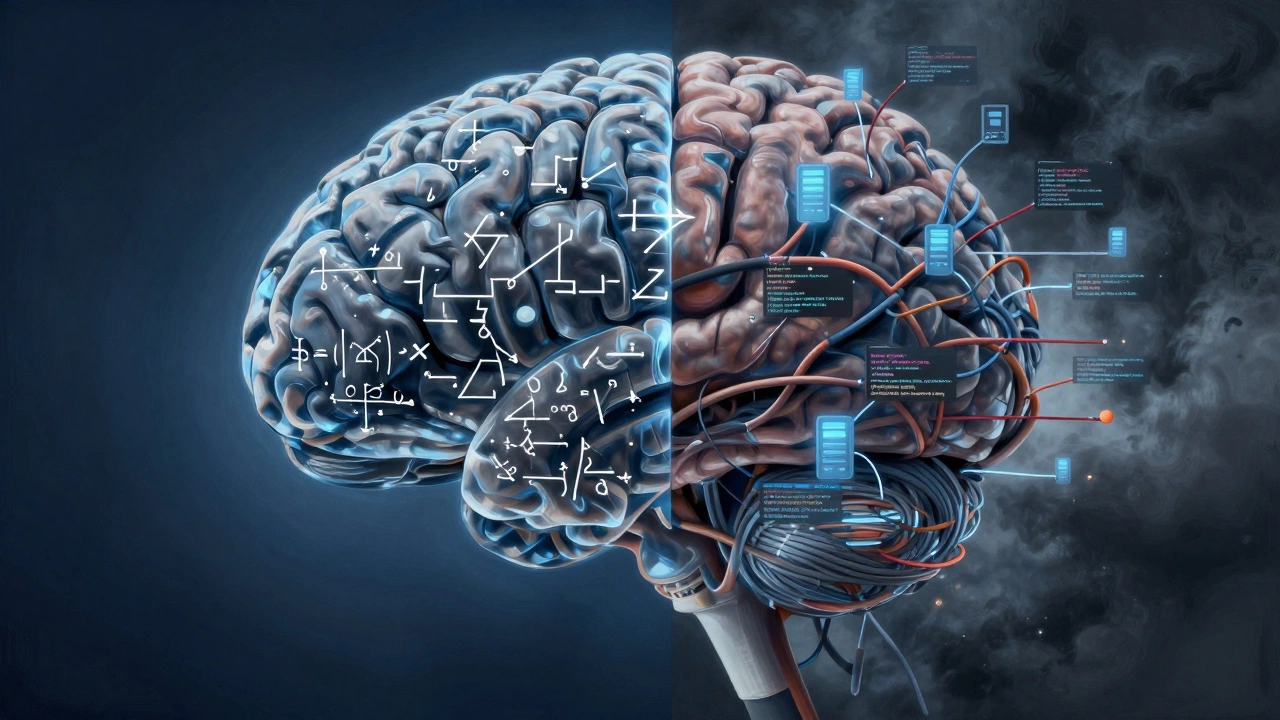
Take a data scientist. They use math to build models. But they use coding to make those models run on real data. One wrong variable name in Python, and their entire model crashes. But if they misunderstand the assumption behind linear regression? The model gives them garbage-and they won’t even know it.
Or consider a game developer. They use trigonometry to make characters move in circles. But they also have to handle input lag, frame drops, and collision detection across 100 different devices. The math is fixed. The code? It’s a living, breathing mess.
And what about AI engineers? They need calculus to understand gradient descent. But they also need to manage GPU memory, debug TensorFlow errors, and handle data pipelines that break every time a new version of PyTorch drops. The math tells them what to do. The code tells them how to do it-and whether it works.
Bottom Line: They’re Different Tools
Coding and math aren’t rivals. They’re tools in different toolkits. Math is your ruler and compass. It gives you truth. Coding is your hammer and screwdriver. It gives you function.
You don’t need to be a math genius to code. Many top developers never took calculus beyond high school. And you don’t need to know how to build a website to understand differential equations.
But if you’re trying to pick one to learn first? Ask yourself:
- Do you want to build something that works, even if it’s messy?
- Or do you want to understand why something must be true, no matter what?
If it’s the first-you’ll lean toward coding. If it’s the second-you’ll lean toward math.
Neither is harder. But one will feel more natural. And that’s the only thing that matters.