
NEET Faculty Matchmaker Tool
Find Your Ideal NEET Mentor
Answer 3 quick questions to discover your perfect teaching match
Loading...
Description goes here.
What to look for in a teacher:
Pro Tip: General tip.
You’ve probably heard the phrase "it’s not just about studying hard; it’s about studying smart." But in the high-stakes world of NEET is the National Eligibility cum Entrance Test, the gateway to medical colleges in India, smart studying often means having the right guide. The question isn't just whether you need coaching-it's who should be teaching you. With thousands of institutes and hundreds of teachers claiming to be the "best," how do you actually pick the faculty that will help you crack the exam?
The truth is, there is no single "best" teacher for every student. What works for a topper from Kota might completely confuse a beginner in Delhi. Your success depends on matching your learning style with a mentor who can bridge the gap between complex concepts and exam-ready answers.
Why Faculty Matters More Than Study Material
We often obsess over the thickness of study materials or the number of mock tests available. While those are important, they are tools. The faculty is the hand that wields them. A great teacher doesn’t just read from NCERT books-they decode them. They take a dense chapter like Human Physiology or Organic Chemistry and break it down into logical stories that stick in your memory.
Consider this: NEET has shifted towards application-based questions in recent years. Rote memorization rarely works anymore. You need a mentor who teaches you *how* to think, not just *what* to remember. A strong faculty member anticipates where the examiner will set traps and prepares you to avoid them. They provide context, connecting biology facts to real-life scenarios, which makes retention significantly easier.
Identifying the Right Teaching Style for You
Before you sign up for any course, ask yourself how you learn best. Are you someone who needs visual diagrams to understand a concept? Or do you prefer step-by-step numerical breakdowns? Your ideal faculty member will align with this preference.
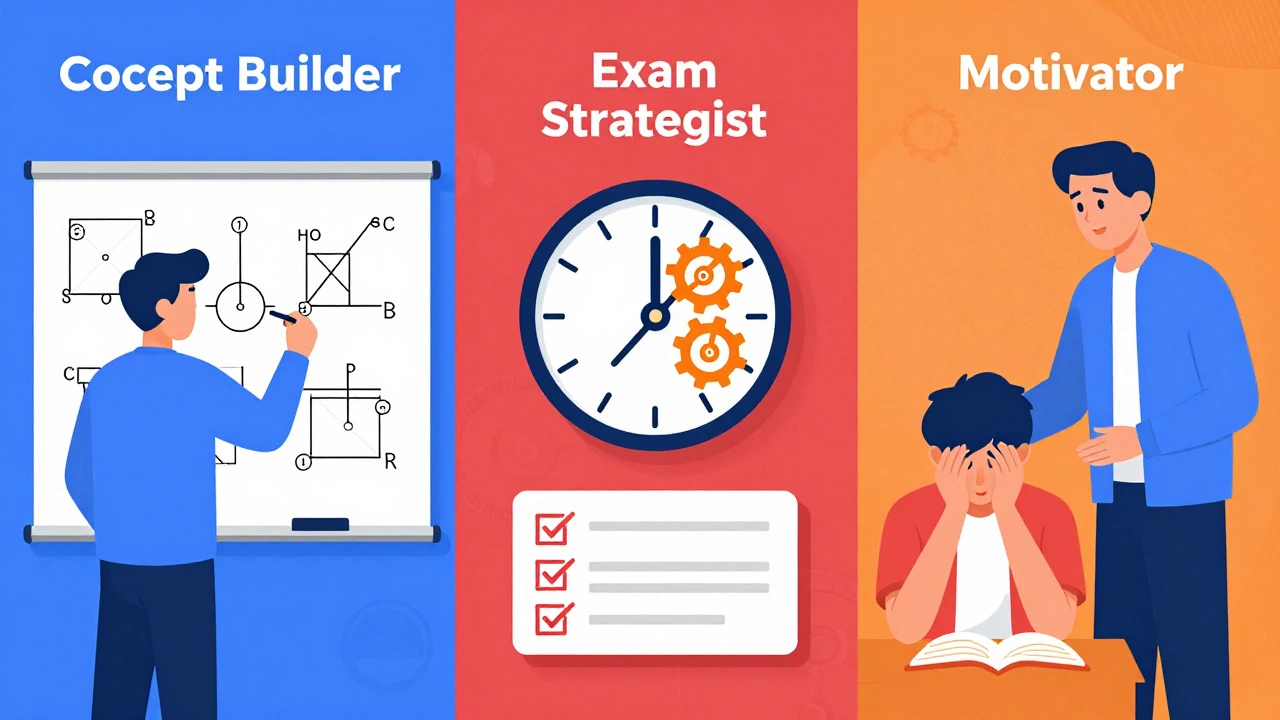
- The Concept Builder: These teachers focus heavily on the 'why' behind every fact. They are excellent for students who struggle with understanding core principles in Physics and Chemistry. If you find yourself memorizing formulas without knowing when to use them, look for a teacher who derives equations from scratch.
- The Exam Strategist: Some mentors specialize in speed and accuracy. They teach shortcuts, elimination techniques, and time-management hacks. This style is crucial for Biology, where reading speed matters as much as knowledge. If you know the material but run out of time, this is your match.
- The Motivator: NEET preparation is a marathon. Some students burn out because they lack emotional support. Teachers who combine academic rigor with regular motivation sessions can keep you going during the tough months of revision.
Subject-Specific Criteria for Choosing Mentors
Different subjects require different strengths from a teacher. Here is what to look for in each domain:
| Subject | Primary Skill Needed | Red Flags to Avoid |
|---|---|---|
| Biology | Clarity and detail orientation | Teachers who skip NCERT lines or rely only on external books |
| Physics | Problem-solving approach | Instructors who only solve easy problems or rush through derivations |
| Chemistry | Logical connection building | Those who treat Organic Chemistry as pure memorization |
For Biology, the teacher must be deeply aligned with NCERT. Since 90% of Biology questions come directly from these textbooks, a mentor who encourages deviating too early into advanced texts can actually hurt your score. Look for someone who highlights specific lines, diagrams, and even footnotes.
In Physics, the best faculty members don’t just give you the answer. They show you multiple ways to arrive at it. They emphasize dimensional analysis and unit checks-simple tricks that can save minutes during the actual exam. If a teacher cannot explain a concept simply, they haven’t mastered it themselves.
Chemistry sits in the middle. Physical Chemistry requires a math-like mindset, while Organic Chemistry needs a flow-chart approach. A good chemistry teacher switches gears seamlessly between calculation-heavy topics and mechanism-based reasoning.
The Experience vs. Passion Debate
A common dilemma is choosing between a veteran teacher with 20 years of experience and a younger, more energetic mentor. Both have merits. Experienced teachers have seen every pattern the exam board throws at them. They know which chapters are frequently tested and which are safe to skim. Their confidence can be contagious.
However, younger teachers often bring fresh energy and updated methods. They are usually more tech-savvy, incorporating apps, digital flashcards, and interactive simulations into their lessons. For Gen Z students who are used to digital interfaces, this modern approach can make learning feel less like a chore and more like an engaging activity.
The sweet spot? A team approach. Many top institutes now offer a hybrid model where senior mentors handle core conceptual lectures, while junior, passionate coaches lead doubt-clearing sessions and daily practice drills. This gives you the wisdom of experience with the agility of new methods.

Evaluating Track Record Without Falling for Hype
Every institute claims to have produced "toppers." How do you verify this? Don’t just look at the rank list. Ask for feedback from current students, not just past successes. Current students will tell you if the pace is too fast, if doubts are ignored, or if the teaching is inconsistent.
Look for consistency in results over the last three years. One lucky batch doesn’t prove quality. Sustained performance indicates a robust teaching system. Also, check if the faculty stays long-term. High turnover rates among teachers suggest poor management or burnout, which disrupts your learning continuity.
Another metric is the availability of recorded lectures. In 2026, with flexible learning being the norm, a faculty member who offers high-quality, searchable video archives adds immense value. It allows you to revisit tricky topics without waiting for the next live session.
Practical Steps to Find Your Ideal Mentor
Start by attending demo classes. Most reputable centers offer free introductory sessions. Pay attention to how the teacher interacts with the audience. Do they encourage questions? Do they pause to ensure everyone understands before moving on? Or do they race through slides hoping you’ll catch up later?
Talk to seniors who have recently given NEET. Ask them specifically about their favorite teachers and why. Did a particular mentor help them overcome a weak subject? Personal anecdotes are more revealing than marketing brochures.
Finally, trust your gut. If you feel bored or confused after a few sessions, switch. You are investing hundreds of hours with this person. Comfort and clarity are non-negotiable. Remember, the best faculty is not the one with the biggest title, but the one who makes you feel capable of scoring 700+.
Is online faculty as effective as offline coaching for NEET?
Yes, provided the platform offers interactive features like live doubt resolution and personalized feedback. Online faculty often uses better visual aids and allows you to control the pace of learning. However, self-discipline is crucial since you lack the physical classroom environment.
How many teachers should I follow for each subject?
Stick to one primary teacher per subject to avoid confusion in methodology. You can supplement with short videos from other experts for specific difficult topics, but changing core mentors mid-preparation can disrupt your foundation.
What if I don't understand a topic taught by my main faculty?
Don't panic. Use alternative resources like YouTube channels or peer discussions to get a second perspective. Sometimes, a different explanation style clicks immediately. Return to your main faculty once the concept is clear to reinforce it.
Should I prioritize famous teachers or local experienced ones?
Fame doesn't guarantee compatibility. Local teachers may offer more personal attention and better access for doubt clearing. Choose based on teaching style and accessibility rather than reputation alone.
How important is the teacher's ability to simplify complex topics?
It is critical. NEET covers vast syllabi. Teachers who simplify complex topics save you hours of struggle and reduce stress. Look for mentors who use analogies and real-world examples to make abstract concepts concrete.