Python Learning Roadmap Estimator
Configure Your Profile
Your Estimated Timeline
Phase 1: The Basics
Weeks 1-4
Variables, loops, functions, and basic syntax. Writing simple scripts.
Phase 2: Data Structures
Months 2-3
Lists, dictionaries, file handling, and error management. Automating small tasks.
Phase 3: Advanced Concepts
Months 4-6
OOP, APIs, external libraries, and building functional applications.
Phase 4: Specialization
6+ Months
Deep dive into your chosen field. Portfolio projects.
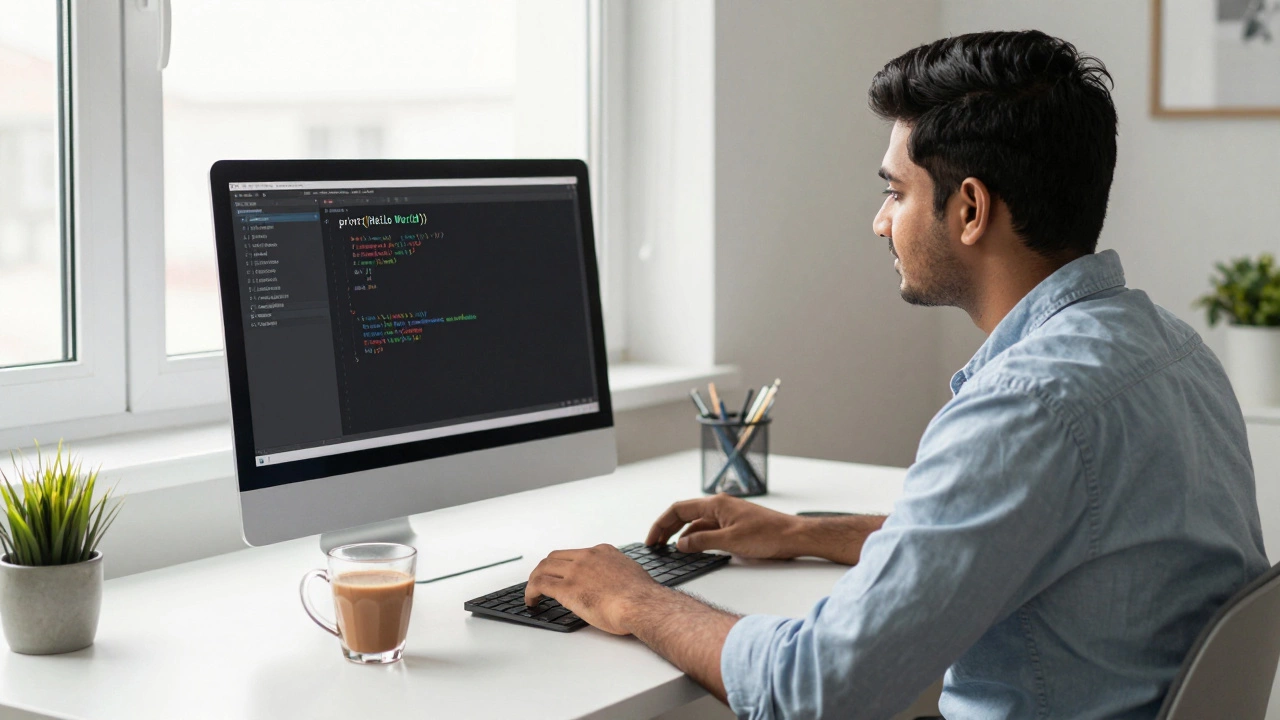
Imagine sitting down at your computer, opening a blank text file, and typing three words: print("Hello World"). You hit run. The screen displays your greeting. No complex setup, no confusing symbols, just immediate feedback. This is the experience most people have when they start with Python, which is a high-level, interpreted programming language known for its readability and simplicity. It is widely considered one of the easiest languages to pick up, especially if you are comparing it to older giants like C++ or Java.
But "easy" is a tricky word. Does easy mean you can build an app in an hour? Or does it mean you won’t get frustrated by syntax errors on day one? For someone looking into coding classes or self-study resources in 2026, the answer depends on what you want to build. If your goal is data analysis, web development, or automation, Python is incredibly accessible. If you want to write video games from scratch or manage low-level hardware, it might feel limiting-and frustratingly abstract-at first.
The Syntax Advantage: Why Python Feels Like English
The biggest reason people say Python is not hard to learn is its syntax. In many programming languages, you have to tell the computer exactly where a block of code starts and ends using curly braces {} or keywords like end. In Python, you use indentation. If you indent four spaces, that code belongs to the previous line. It forces clean formatting and makes the code look like a structured outline rather than a wall of symbols.
Consider how you define a variable. In Java, you must declare the type: int age = 25;. In Python, you just say age = 25. The language figures out that it’s a number. This dynamic typing removes a huge mental hurdle for beginners. You don’t need to understand memory management or data types deeply before you can write useful scripts. This lowers the barrier to entry significantly, allowing new learners to focus on logic rather than grammar.
| Language | Syntax Difficulty | Setup Complexity | Best For |
|---|---|---|---|
| Python | Low (Readable) | Very Low | Data Science, Web Dev, Automation |
| JavaScript | Medium (Flexible) | Low (Browser-based) | Web Frontend, Interactive UIs |
| Java | High (Verbose) | Medium | Enterprise Apps, Android |
| C++ | Very High (Complex) | High | Game Engines, Systems Programming |
The Hidden Challenges: Where Beginners Get Stuck
While the syntax is forgiving, the concepts behind programming are universal and can be tough. Learning Python doesn't exempt you from understanding loops, conditionals, functions, and data structures. These are the building blocks of all software. Many students think learning Python means skipping these fundamentals, but that’s a misconception. You still need to think logically.
One common stumbling block is Object-Oriented Programming (OOP), which is a paradigm based on objects containing data and methods. Python supports OOP, but it allows you to ignore it for a long time. You can write hundreds of lines of procedural code without ever defining a class. However, once you try to join a professional team or work on large projects, you’ll hit a wall. Understanding inheritance, polymorphism, and encapsulation takes time and practice, regardless of the language.
Another challenge is the sheer number of libraries. Python has a massive ecosystem. There is a library for almost everything-web scraping, machine learning, financial modeling, and even controlling robots. This is great, but it can be overwhelming. Which library should you use for data visualization? Matplotlib, which is a plotting library for creating static, animated, and interactive visualizations,? Seaborn, which is a statistical data visualization library based on Matplotlib,? Or Plotly, which is an interactive graphing library,? Deciding which tool fits your specific problem is part of the learning curve.
Why Coding Classes Accelerate Your Progress
You can teach yourself Python using free tutorials, but structured coding classes offer distinct advantages. First, they provide a curriculum. Instead of bouncing between random YouTube videos, you follow a logical path from basics to advanced topics. This prevents gaps in your knowledge.
Second, feedback is crucial. When you’re stuck on a bug, a teacher or mentor can spot the issue in seconds. Self-learners often spend hours debugging a missing colon or incorrect indentation. In a classroom setting, whether online or offline, you get immediate correction. This builds good habits early on.
Third, accountability helps. Motivation wanes quickly when coding gets difficult. Having deadlines, peer groups, and instructor check-ins keeps you moving forward. Many successful developers credit their initial progress to the structure provided by formal courses.
Real-World Applications: What Can You Build?
Understanding what you can do with Python makes the learning process more engaging. Here are some practical projects beginners often tackle:
- Automating Boring Stuff: Write a script to rename thousands of files, send automated emails, or scrape prices from e-commerce sites. This gives instant gratification.
- Data Analysis: Use Pandas, which is a fast, powerful, flexible and easy-to-use open source data analysis and manipulation tool, to clean and analyze Excel sheets. This is highly valued in business roles.
- Web Development: Build a simple website using Flask, which is a lightweight WSGI web application framework, or Django, which is a high-level Python web framework that encourages rapid development. Django includes security features and database management out of the box.
- Machine Learning Basics: Experiment with Scikit-learn, which is a free software machine learning library for the Python programming language, to predict house prices or classify images. This opens doors to AI careers.
How Long Does It Take to Learn Python?
The timeline varies based on your background and goals. If you study for 10-15 hours a week, here’s a realistic expectation:
- Weeks 1-4: Basic syntax, variables, loops, and functions. You can write simple scripts.
- Months 2-3: Data structures (lists, dictionaries), file handling, and basic error handling. You can automate small tasks.
- Months 4-6: Object-oriented programming, working with APIs, and using external libraries. You can build small web apps or data dashboards.
- 6+ Months: Specialization. Dive deep into web development, data science, or automation. Start contributing to open-source projects or building a portfolio.
Remember, fluency comes from building things, not just reading about them. The sooner you start coding real projects, the faster you’ll learn.

Tips for Success in Your Python Journey
To make your learning smoother, keep these strategies in mind:
- Code Every Day: Even 20 minutes daily is better than 5 hours once a week. Consistency builds muscle memory.
- Read Error Messages: Don’t panic when you see red text. Python error messages are usually helpful. Read them carefully; they often tell you exactly which line is wrong.
- Use a Good Editor: Tools like VS Code, which is a code editor redefined and optimized for building and debugging modern web and cloud applications, or PyCharm, which is an integrated development environment used in computer programming, specifically for the Python language, provide auto-completion and debugging tools that save time.
- Join a Community: Platforms like Stack Overflow, Reddit’s r/learnpython, or local meetups offer support. Asking questions is a skill in itself.
- Don’t Copy-Paste Blindly: Type out the code yourself. Typing reinforces learning in a way copying never will.
Conclusion: Is Python Right for You?
Python is not magic. It requires effort, patience, and logical thinking. But compared to other languages, it offers the gentlest slope for beginners. Its readability reduces frustration, and its versatility ensures that your skills remain relevant in various industries. Whether you choose self-study or enroll in dedicated coding classes, the key is to start small, stay consistent, and build projects that interest you. By 2026, Python remains a top choice for both newcomers and seasoned developers looking to expand their toolkit.
Do I need math skills to learn Python?
Basic arithmetic is enough for general programming. However, if you plan to dive into data science or machine learning, a stronger grasp of statistics and linear algebra will be beneficial. For web development or automation, minimal math is required.
Can I learn Python without any prior coding experience?
Absolutely. Python is designed to be beginner-friendly. Its syntax resembles plain English, making it easier to understand for those who have never written code before. Many successful developers started with Python as their first language.
What is the best way to practice Python?
Build small projects. Start with simple scripts like a calculator or a to-do list, then move to more complex applications like a weather app or a data dashboard. Websites like LeetCode and HackerRank also offer coding challenges to test your skills.
Is Python slow compared to other languages?
Yes, Python is generally slower than compiled languages like C++ or Java because it is interpreted. However, for most applications, the difference is negligible. Performance-critical parts can be written in C or optimized using libraries like NumPy.
Should I take a coding class or learn online?
It depends on your learning style. Online tutorials offer flexibility and cost savings, while coding classes provide structure, mentorship, and accountability. If you struggle with self-discipline, a class might be more effective. Hybrid approaches, combining online resources with occasional workshops, are also popular.