
Vocational Training Qualifier
Is it Vocational Training?
Check if your training program qualifies as legitimate vocational training based on Australian industry standards
Real Examples
- Electrician Qualifies (Certificate III in Electrotechnology)
- Commercial Cook Qualifies (Certificate III in Commercial Cookery)
- Business Administration Qualifies (Certificate IV in Business Administration)
- Marketing Manager Doesn't Qualify (Typically requires bachelor's degree)
- Healthcare Assistant Qualifies (Certificate III in Health Services)
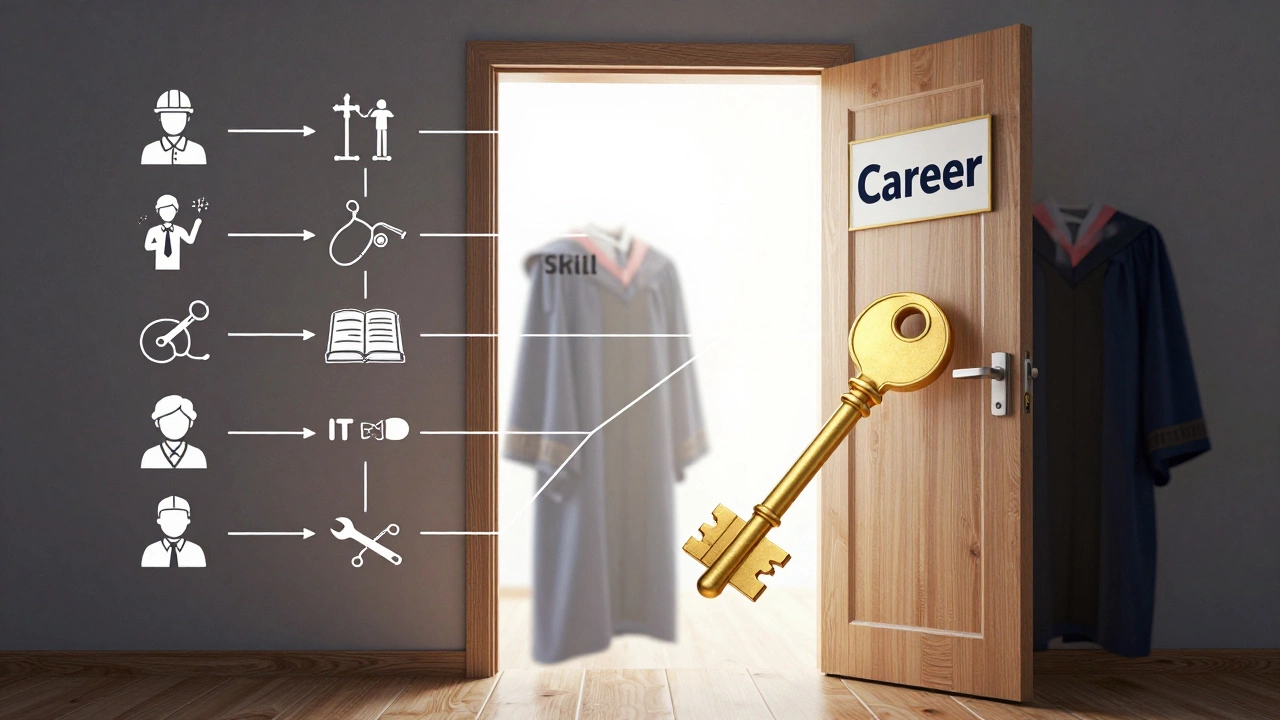
Think vocational training is just for people who don’t want to go to university? That’s a myth. Vocational training isn’t about what you don’t do-it’s about what you can do. It’s hands-on, practical, and gets you hired faster than most degrees. You don’t need a four-year diploma to become a skilled electrician, a certified welder, or a qualified aged care worker. All you need is the right kind of training-and it’s more common than you think.
Vocational training isn’t theory-it’s doing
Most school or university courses teach you how to explain something. Vocational training teaches you how to do it. You learn by doing, not by memorizing. In a vocational course, you don’t just read about plumbing-you install pipes. You don’t just watch a video on welding-you hold the torch and make the joint. The feedback is immediate. If your weld cracks, you fix it. If your circuit shorts, you trace the error. There’s no grade based on an essay. Your skill is the grade.
This kind of learning works because it’s tied to real jobs. Employers don’t hire people who can recite safety codes. They hire people who can fix a broken boiler, wire a house, or operate a CNC machine on day one. That’s why vocational training has a 78% employment rate within six months of completion in Australia, according to the Department of Employment and Workplace Relations. Compare that to the 52% rate for recent bachelor’s degree holders in non-professional fields.
What counts as vocational training? Real examples
Not every job that needs skills is vocational. But here’s what definitely is:
- Trade certifications: Electrician, plumber, carpenter, refrigeration technician. These require formal apprenticeships and nationally recognized qualifications like Certificate III in Electrotechnology or Certificate III in Plumbing.
- Health support roles: Aged care worker, disability support worker, dental assistant. These aren’t nursing degrees-they’re short, focused courses that teach you how to assist, not diagnose.
- Automotive and mechanical: Mechanic, auto electrician, diesel fitter. You learn on actual vehicles, not simulations.
- Beauty and personal services: Hairdressing, nail technician, barbering. These are hands-on, client-facing roles with strict licensing requirements.
- Construction and building: Bricklayer, painter, tiler, roofing contractor. Each has its own certification path through TAFE or private RTOs.
- Information technology support: IT support technician, network cabling, help desk. These aren’t software engineering degrees-they’re about fixing computers, setting up networks, and answering user questions.
- Cooking and hospitality: Commercial cookery, patisserie, kitchen management. Think Cert III in Commercial Cookery-not culinary school with 100-page textbooks.
Notice a pattern? These aren’t abstract. They’re tied to specific tools, tasks, and industry standards. You don’t need to write a thesis. You need to pass a practical assessment.
How it’s different from college or university
Let’s clear up the confusion. A university degree is often about broad knowledge, critical thinking, and research. A vocational course is about precision, repetition, and mastery of a defined skill set.
Take two people: one with a Bachelor of Business, another with a Certificate IV in Business Administration. The first might know how to analyze market trends. The second can set up a CRM system, manage invoices, and schedule meetings without being told. One is theoretical. The other is operational.
Vocational training is also faster and cheaper. A Certificate III in Electrotechnology takes 2-3 years, including apprenticeship. A four-year engineering degree costs $100,000+ and still leaves you needing on-the-job training. The electrician earns while they learn. The engineer graduates with debt and no hands-on experience.

Who benefits most from vocational training?
It’s not just for people who ‘couldn’t get into university.’ It’s for:
- Teenagers who know they want to work with their hands.
- Adults switching careers after layoffs or burnout.
- Parents who need flexible, part-time training while caring for kids.
- Immigrants who need recognized qualifications to work in Australia.
- People in regional areas where jobs are tied to trades, not offices.
In Sydney, for example, there are over 12,000 open positions in construction trades alone, according to the Australian Bureau of Statistics. Many of these roles pay $70,000-$110,000 a year with overtime. You don’t need a degree to qualify. You need a ticket.
Where to find legitimate vocational training
Not all training providers are equal. Stick to these:
- TAFE NSW: Government-run, nationally recognized, affordable. Offers everything from hairdressing to heavy vehicle mechanics.
- Registered Training Organisations (RTOs): Private providers approved by the Australian Skills Quality Authority (ASQA). Check their registration status on the training.gov.au website.
- Apprenticeships and traineeships: Paid work + structured training. You’re employed from day one. Find openings through JobActive or MySkills.
Avoid providers that promise ‘guaranteed jobs’ or charge $10,000 for a 6-week course. If it sounds too good to be true, it is. Legitimate vocational training follows national training packages and leads to accredited qualifications.
Myths about vocational training
Let’s bust the big lies:
- Myth: Vocational training is for ‘less smart’ people. Truth: You need strong problem-solving skills to troubleshoot a faulty circuit or diagnose a transmission issue. It’s not easy-it’s different.
- Myth: You’ll never earn as much. Truth: A qualified plumber in Sydney can earn $120,000+ with overtime. Many earn more than graduates in marketing or communications.
- Myth: There’s no career growth. Truth: You can become a supervisor, start your own business, or move into training others. Many trade businesses are family-run for generations.
- Myth: It’s only for men. Truth: Women make up 32% of apprentices in construction and 45% in aged care. The field is changing.
What’s next? How to start
If you’re considering vocational training, here’s how to begin:
- Identify a job you’d actually enjoy doing-something you’d do even if you weren’t getting paid.
- Search for the official qualification on training.gov.au. Look for the code (e.g., UEENEEJ165A for electrical fault finding).
- Find a TAFE or RTO that offers it. Check reviews and student outcomes.
- Ask about payment options. Many courses are subsidized under NSW government programs. Some are even free for eligible people.
- Apply for an apprenticeship if you can. It’s the fastest way to earn and learn.
You don’t need to be 18. You don’t need to be a straight-A student. You just need to be willing to show up, learn, and do the work.
Is vocational training the same as an apprenticeship?
No, but they often go together. Vocational training is the learning part-it’s the course you take to gain a qualification. An apprenticeship is a paid job where you learn that skill on the job, usually while also attending classes. Most trade qualifications require both: on-the-job training (the apprenticeship) and formal coursework (the vocational training).
Can I do vocational training online?
Some parts, yes. Theory modules-like safety rules, workplace regulations, or basic math for carpenters-can be done online. But the hands-on part? No. You can’t learn to weld, cut hair, or fix a car engine through a screen. Legitimate vocational training requires supervised practical assessments. Be wary of any course that claims to give you a full certification online without any in-person work.
Do employers value vocational training?
Absolutely. In skilled trades, employers care about your ticket, not your resume. If you’ve got a Certificate III in Plumbing and a clean work record, you’ll get hired before someone with a business degree who’s never held a wrench. Many companies even pay for their employees to get certified because they know the return on investment is immediate.
Is vocational training only for young people?
Not at all. In fact, the fastest-growing group in vocational training in Australia is adults over 40. People switching careers after redundancy, parents returning to work, or retirees looking for part-time income are all choosing trade courses. Many programs offer flexible hours, part-time options, and even childcare support.
Can I get government help to pay for vocational training?
Yes. In NSW, the Smart and Skilled program subsidizes training in priority areas like construction, health, and IT support. Some courses are free for eligible students. Federal programs like JobTrainer also offer fee-free or low-cost training. Check your eligibility on the MySkills website-it only takes five minutes.
Final thought: Skills are the new currency
The job market isn’t waiting for another generation of graduates with degrees in things no one needs. It’s hiring people who can fix things, build things, care for people, and keep systems running. Vocational training isn’t a backup plan. It’s the most direct path to a stable, well-paid career-with no student debt, no waiting, and no guesswork.