
JEE Pathway & Score Estimator
Enter Your Scores
Input your marks in Physics, Chemistry, and Mathematics (Max 30 each).
Analysis Report
Eligibility Prediction:
- ⚪ JEE Main: Good attempt for CFTIs.
- ⚪ JEE Advanced: Likely not qualified.
- ⚪ IIT Admission: Out of reach currently.
You’ve probably heard the acronym tossed around in every serious academic conversation in India. Parents whisper it with a mix of hope and anxiety. Students dread it or dream of conquering it. But if you are new to this ecosystem, you might be scratching your head: what does JEE stand for? It is not just a random string of letters; it represents one of the most rigorous testing systems in the world.
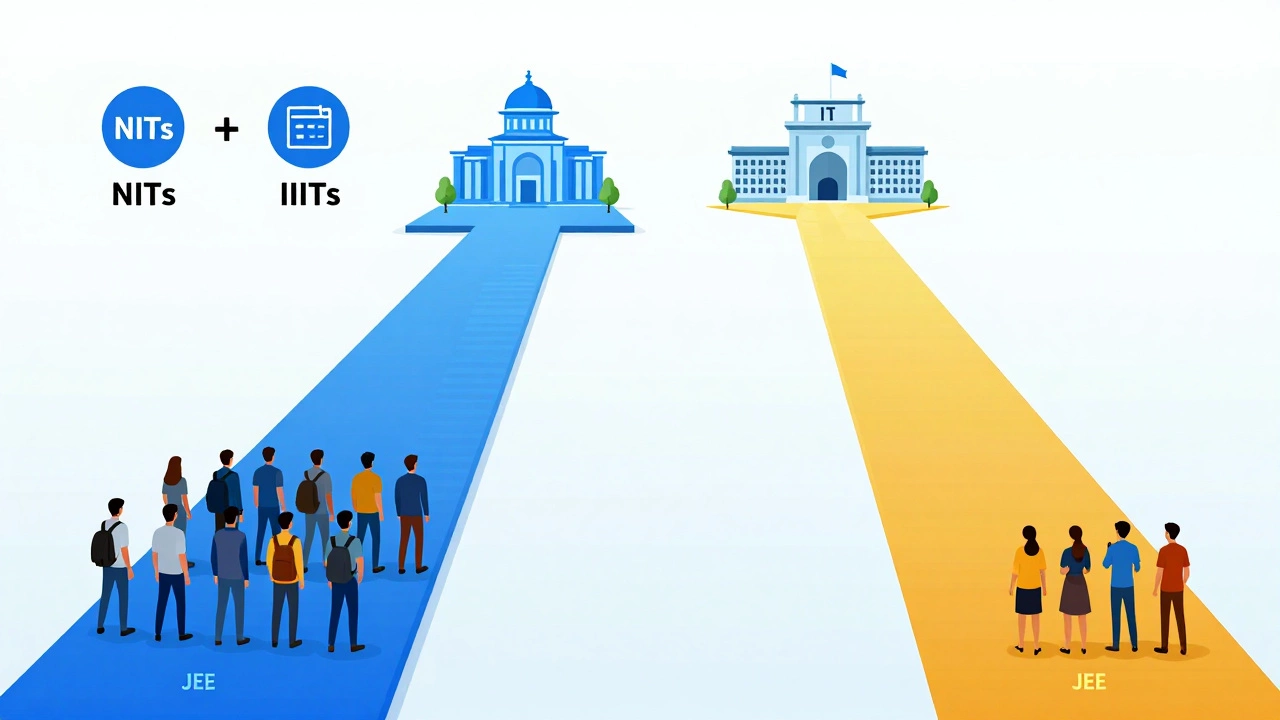
JEE stands for Joint Entrance Examination. It is the gateway to premier engineering institutions in India, including the Indian Institutes of Technology (IITs), National Institutes of Technology (NITs), and other centrally funded technical institutions (CFTIs). Getting into these colleges isn't just about getting good grades in school; it requires mastering a specific, highly competitive exam format that tests your depth of understanding in Physics, Chemistry, and Mathematics.
The Two-Tier System: JEE Main vs. JEE Advanced
To understand the exam, you need to understand its structure. The Joint Entrance Examination is split into two distinct stages. This two-tier system was designed to filter candidates progressively, ensuring that only those with the highest aptitude reach the final stage.
| Feature | JEE Main | JEE Advanced |
|---|---|---|
| Conducting Body | National Testing Agency (NTA) | One of the seven IITs (rotates yearly) |
| Purpose | Admission to NITs, IIITs, CFTIs; Qualifier for Advanced | Admission to IITs only |
| Eligibility | Class 12 passed or appearing | Top 2.5 lakh rankers in JEE Main |
| Exam Format | Online, Multiple Choice Questions (MCQ) & Numerical Value | Online, Mixed types (MCQ, Integer, Matrix Match) |
| Difficulty Level | High (Broad coverage) | Very High (Deep conceptual application) |
JEE Main acts as the first filter. It is conducted by the National Testing Agency (NTA). In recent years, typically four sessions are held throughout the year, giving students multiple chances to improve their scores. Your best score across these sessions is usually considered for the final ranking. This exam determines your eligibility for admission to National Institutes of Technology (NITs) and Indian Institutes of Information Technology (IIITs).
If you perform well enough in JEE Main-specifically, if you fall within the top 2.5 lakh candidates-you qualify for JEE Advanced. This is the holy grail for many aspirants. Unlike JEE Main, JEE Advanced is conducted by the IITs themselves. The question paper is notoriously difficult, focusing less on rote memorization and more on complex problem-solving, multi-concept integration, and time management under pressure.
Who Actually Takes This Exam?
Understanding the audience helps you gauge the competition. You aren't just competing against your classmates; you are competing against hundreds of thousands of students from across India and abroad who have dedicated years to this goal.
- Class 12 Students: The primary demographic. They balance their board exams with JEE preparation simultaneously.
- Dropouts (Gap Year Students):strong>: Many students take a year off after Class 12 to prepare exclusively for JEE. These candidates often have an edge because they can dedicate 12-14 hours a day to studying without the distraction of school curriculum.
- International Students: NRI (Non-Resident Indian) and foreign national candidates also participate, adding another layer of diversity to the applicant pool.
The competition is fierce. With over a million applicants for JEE Main annually, the cut-off percentile for even the last seat in a decent NIT can be extremely high. For IITs, you typically need to be in the top 0.1% of all test-takers.
The Core Subjects: What You Need to Master
The syllabus for both JEE Main and JEE Advanced is derived from the NCERT textbooks for Class 11 and 12, but it goes much deeper. You cannot simply read the textbook; you must apply concepts to novel situations.
Physics: This subject tests your ability to visualize real-world phenomena through mathematical models. Key areas include Mechanics (Newton’s Laws, Rotational Motion), Electrodynamics, Modern Physics, and Thermodynamics. In JEE Advanced, you will often find questions that combine optics with mechanics or electricity with magnetism.
Chemistry: This is divided into three parts: Physical, Organic, and Inorganic. Physical Chemistry involves calculations and concepts similar to physics. Organic Chemistry requires logical reasoning and mechanism understanding. Inorganic Chemistry is heavily fact-based, requiring memorization of trends, exceptions, and compound properties. A strong foundation in Inorganic Chemistry is crucial because it offers quick marks if you know the facts.
Mathematics: Often considered the most scoring yet most time-consuming section. Topics like Calculus (Limits, Derivatives, Integrals), Algebra (Matrices, Determinants, Complex Numbers), and Coordinate Geometry form the backbone. Speed and accuracy are paramount here because solving a single integral-based problem can take 10-15 minutes.
How to Prepare Effectively in 2026
Preparation strategies have evolved. Gone are the days when solving thousands of problems blindly was enough. Today, smart preparation is key.
- Build Concepts First: Do not jump into advanced problem sets until you understand the basics. Use standard reference books like HC Verma for Physics and RD Sharma for Mathematics alongside NCERT.
- Mock Tests are Non-Negotiable: Start taking full-length mock tests early. Analyze your performance not just by score, but by error type. Did you make a silly calculation mistake? Or did you lack the concept? This analysis drives improvement.
- Time Management: JEE Advanced is a marathon, not a sprint. Learn to skip questions. If a problem looks too long, move on. Coming back to it later is better than getting stuck and missing easier questions.
- Consistency Over Intensity: Studying 10 hours for three days and then burning out is worse than studying 6 hours consistently for six months. Regular revision cycles help retain information.
Common Myths About JEE
Misinformation spreads quickly among students. Let’s clear up some common misconceptions.
Myth 1: You need to be a genius to crack JEE. Reality: Hard work and strategy matter more than raw intelligence. Many average students crack IITs through disciplined preparation.
Myth 2: Coaching is mandatory. Reality: While coaching provides structure and resources, self-study with the right materials (like previous years' papers and standard books) can be equally effective if you are self-disciplined.
Myth 3: JEE Main is easy compared to Advanced. Reality: Don’t underestimate JEE Main. The volume of syllabus covered is vast, and the speed required to complete the paper is high. Many students fail to qualify for Advanced because they neglected Main.
Life After JEE
Cracking JEE opens doors to world-class education. The alumni network of IITs and NITs is powerful, leading to opportunities in top global companies, research institutions, and startups. However, remember that JEE is just one chapter in your life. It shapes your discipline and resilience, skills that are valuable regardless of where you end up working.
Is JEE only for IITs?
No. JEE Main scores are used for admissions to NITs, IIITs, and other Centrally Funded Technical Institutions (CFTIs). Only JEE Advanced scores are used for admission to the Indian Institutes of Technology (IITs).
Can I appear for JEE if I am not in Class 12?
Yes, you can appear for JEE if you have already passed Class 12 or an equivalent examination. There is no age limit for JEE Main, but for JEE Advanced, there are specific attempts limits and age criteria defined by the conducting IIT each year.
What is the syllabus difference between JEE Main and Advanced?
The core topics are similar, covering Physics, Chemistry, and Mathematics from Classes 11 and 12. However, JEE Advanced delves deeper into concepts and often includes topics that are less emphasized in JEE Main, such as detailed Semiconductor Electronics or advanced Calculus applications. The difficulty level in Advanced is significantly higher.
How many times can I attempt JEE?
You can attempt JEE Main twice in consecutive calendar years. For example, if you take it in 2026, you can also take it in 2027. For JEE Advanced, you generally get three attempts over your lifetime, provided you meet the age and attempt criteria set by the IITs.
Does JEE have negative marking?
Yes, both JEE Main and JEE Advanced have negative marking for incorrect answers in MCQ sections. Typically, 1 mark is deducted for every wrong answer, while no marks are deducted for unattempted questions. Always check the latest notification for the exact marking scheme as it can change slightly.