Global Syllabus Difficulty Analyzer
Select a syllabus below to visualize its specific difficulty profile based on Content Density, Conceptual Depth, Competitive Intensity, and Total Workload.
CBSE (India)
High CompetitionMarathon preparation for JEE/NEET with massive volume.
Gaokao (China)
Rote MemorizationSingle high-stakes exam determining entire future.
A-Levels (UK)
Deep SpecializationUniversity-level abstraction in fewer subjects.
IB Diploma
Workload MonsterHolistic approach with constant assignments.
Select a system above to see the breakdown.
Imagine sitting for an exam where one wrong answer can cost you a rank that determines your entire future. For millions of students, this isn't a hypothetical scenario; it is their Tuesday afternoon. When people ask, which is the hardest school syllabus in the world, they are usually looking for a single winner. But the truth is messier and more complex. Difficulty is subjective, shaped by cultural expectations, assessment methods, and the sheer volume of content.
In India, the Central Board of Secondary Education (CBSE) is often cited as the toughest. In China, the Gaokao looms large. In the UK, A-Levels demand deep specialization. Each system has its own brand of pressure. To understand which syllabus truly holds the title of "hardest," we need to look beyond reputation and examine the mechanics: workload, competition, depth of knowledge, and psychological toll.
The Indian Context: Why CBSE Gets the Heat
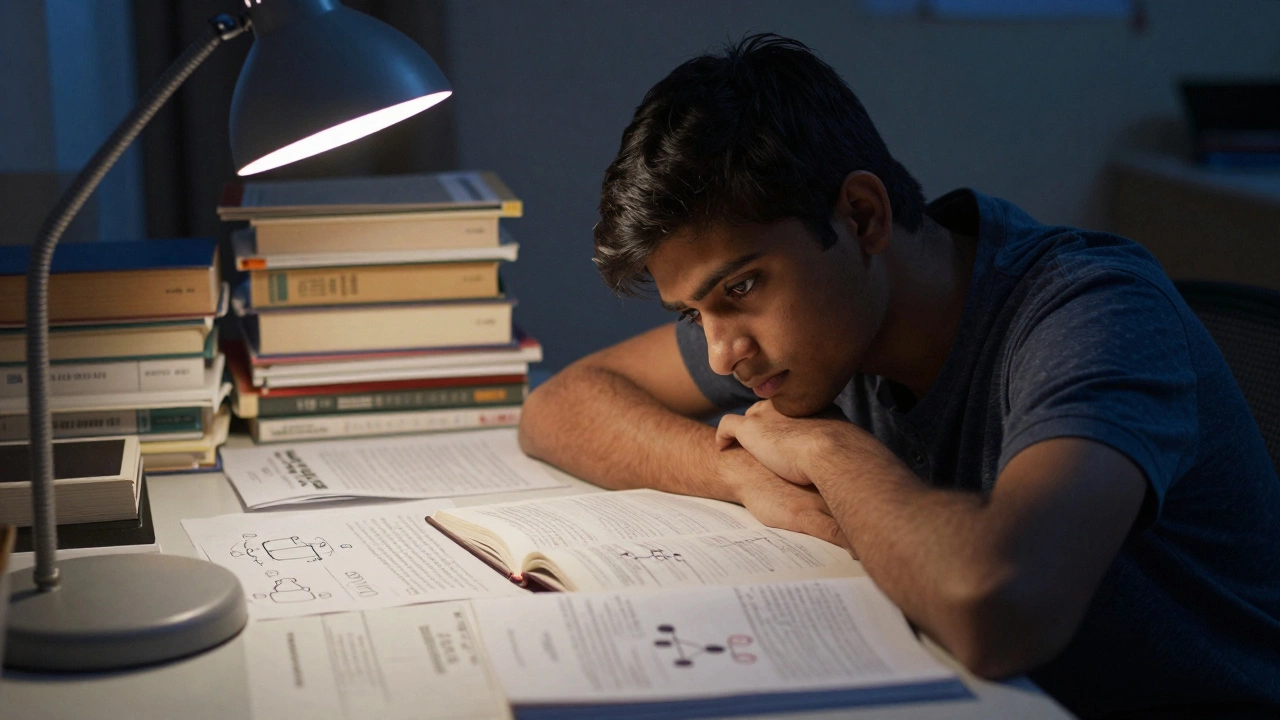
Let’s start with the elephant in the room. The Central Board of Secondary Education (CBSE) is the most popular board of school education in India, catering to over 30% of all school students in the country. It is not just a curriculum; it is a gateway to some of the most competitive entrance exams in the world.
The difficulty of the CBSE syllabus does not come from the textbook content alone. If you look at the Class 12 Physics or Chemistry papers, they are rigorous but manageable. The real challenge lies in what happens *after* the syllabus is finished. Students preparing for the Joint Entrance Examination (JEE) is an engineering entrance examination conducted in India for admission into undergraduate engineering programs must go far beyond the CBSE scope. They tackle advanced calculus, complex mechanics, and organic chemistry reactions that are rarely seen in standard high schools globally.
- Volume of Content: CBSE covers a vast amount of material across five core subjects. There is little room for leisurely exploration.
- Competition Ratio: With millions appearing for JEE Main and Advanced, the cutoff ranks for top institutes like IITs require near-perfect scores. This forces students to master every nuance of the syllabus.
- Coaching Culture: The rise of coaching giants like Allen and FIITJEE has created a parallel syllabus that is significantly harder than the official CBSE curriculum. Students effectively study two curricula simultaneously.
If you judge difficulty by the intensity of preparation required to succeed, CBSE-backed aspirants face a grueling marathon. However, is it the hardest globally? Let’s compare.
The Chinese Gaokao: Pressure Cooker Education
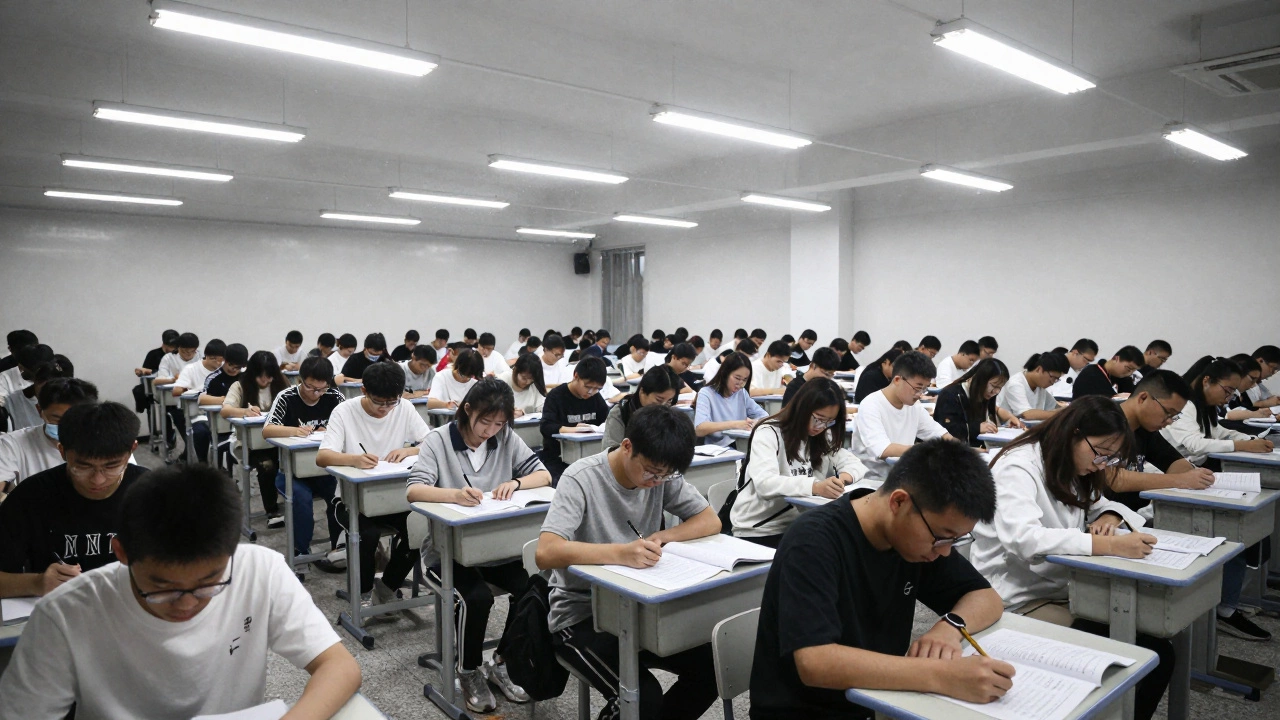
If CBSE is a marathon, the Gaokao is the National College Entrance Examination in China, considered one of the most difficult academic tests in the world is a sprint through a minefield. Held annually in June, this single exam determines university placement for over ten million students. Unlike the US or European systems where holistic admissions consider essays, extracurriculars, and teacher recommendations, the Gaokao score is king.
The syllabus for Gaokao is incredibly dense. Students spend years memorizing classical Chinese literature, solving complex mathematical problems under strict time limits, and mastering foreign languages. The physical toll is visible; many students report sleeping only four to five hours a night during peak preparation months.
| Syllabus/System | Primary Focus | Assessment Style | Key Stressor |
|---|---|---|---|
| CBSE (India) | Broad STEM & Humanities | Board Exams + Entrance Tests | High competition for limited seats |
| Gaokao (China) | Memorization & Speed | Single High-Stakes Exam | All-or-nothing outcome |
| A-Levels (UK) | Deep Specialization | End-of-course Exams | Depth over breadth |
| IB Diploma (Global) | Holistic & Critical Thinking | Exams + Internal Assessments | Workload & Time Management |
The Gaokao syllabus demands rote memorization at a scale that would break most Western students. You cannot bluff your way through a question on ancient poetry or advanced trigonometry. The margin for error is razor-thin. While CBSE students have multiple chances via different entrance exams, Gaokao students often feel they have only one shot.
British A-Levels: Depth Over Breadth
Then there are the A-Levels are Advanced Level qualifications taken by students in England, Wales, and Northern Ireland, typically aged 16-18. Unlike CBSE or Gaokao, which require students to juggle five or six subjects, A-Level students usually pick three or four. Does this make it easier? Not necessarily. It makes it deeper.
An A-Level student studying Mathematics doesn’t just learn algebra; they delve into proof-based logic, differential equations, and statistics at a level comparable to first-year university courses in other countries. The syllabus assumes a high degree of independent thinking. There is no "coaching" shortcut here because the questions are designed to test understanding, not recall.
The difficulty lies in the abstraction. You cannot memorize your way through an A-Level Physics paper if you don’t understand the underlying principles. For students who struggle with conceptual clarity, A-Levels can be brutally punishing. However, the lower student-to-seat ratio in UK universities means the competition, while intense, is not as numerically overwhelming as in India or China.
International Baccalaureate (IB): The Workload Monster
Finally, we have the International Baccalaureate (IB) Diploma is a rigorous pre-university program offered worldwide, known for its holistic approach and heavy workload. If you ask any IB student, they will tell you the difficulty isn’t the content-it’s the volume. IB students take six subjects, plus a Theory of Knowledge (TOK) course, an Extended Essay (4,000 words), and Creativity, Activity, Service (CAS) projects.
The IB syllabus is hard because it never stops. While CBSE students might have breaks between board exams and entrance tests, IB students are constantly producing work. Essays, lab reports, presentations, and exams pile up simultaneously. It teaches time management better than any other syllabus, but it also leads to burnout if not managed carefully.
Is IB harder than CBSE? In terms of pure academic rigor per subject, perhaps not. But in terms of total energy expenditure over two years, IB is a heavyweight champion. It requires you to be a scientist, a writer, a debater, and a volunteer all at once.
What Makes a Syllabus "Hard"?
To settle the debate, we need to define our metrics. Here is how different syllabi stack up against specific criteria:
- Content Density: Gaokao wins. The amount of information to memorize is staggering.
- Conceptual Depth: A-Levels and IB win. They require higher-order thinking skills.
- Competitive Intensity: CBSE/JEE wins. The number of competitors per seat is unmatched.
- Total Workload: IB wins. The constant stream of assignments leaves no downtime.
So, which is the hardest? It depends on what drains you faster. Do you hate memorizing thousands of facts? Avoid Gaokao. Do you struggle with abstract proofs? Avoid A-Levels. Do you crumble under constant deadlines? Avoid IB. And do you panic when millions are competing for the same spot? Then CBSE’s ecosystem might be your worst nightmare.
The Role of Coaching and Resources
One cannot discuss the CBSE syllabus without mentioning the infrastructure around it. In cities like Kota, Rajasthan, entire towns revolve around JEE preparation. Students live in hostels, study 14 hours a day, and follow a structured schedule that eliminates distractions. This environment amplifies the difficulty. The syllabus itself is static, but the expectation level rises every year as more resources become available and more students prepare smarter.
In contrast, the IB relies heavily on self-discipline. There is no "coaching factory" for IB success because the extended essay and TOK are personal journeys. You cannot outsource your critical thinking. This makes IB uniquely challenging for students who thrive on external structure.
Conclusion: It’s About Fit, Not Just Hardness
There is no single "hardest" syllabus. There is only the syllabus that mismatches your strengths. A creative writer might find CBSE’s rigid science focus suffocating, while a math prodigy might find IB’s humanities requirements tedious. The Gaokao’s memorization-heavy approach favors disciplined repeaters, while A-Levels reward deep thinkers.
For Indian students, the CBSE syllabus is undeniably tough due to the post-board exam landscape. But globally, the title is shared among these titans based on different dimensions of difficulty. Understanding this helps students choose a path that aligns with their learning style, rather than just chasing prestige.
Is CBSE harder than ICSE?
Generally, ICSE (Indian Certificate of Secondary Education) is considered more detailed and language-focused, especially in English and Literature. CBSE is more streamlined and science-oriented. However, both are challenging, and the perceived difficulty often depends on whether you are preparing for state-level or national-level entrance exams.
Can I switch from CBSE to IB in Class 11?
Yes, but it requires careful planning. IB emphasizes internal assessments and continuous evaluation, unlike CBSE’s exam-centric approach. You may need to adjust your study habits significantly to meet the writing and research demands of the IB Diploma.
Why is the JEE Advanced considered so difficult?
JEE Advanced tests multi-concept application. Questions often combine physics, chemistry, and mathematics in novel ways. The negative marking scheme adds pressure, and the cutoff percentiles are extremely high, meaning even small mistakes can eliminate you from top-tier institutes.
Which syllabus is best for medical aspirants?
For NEET (National Eligibility cum Entrance Test), the NCERT/CBSE syllabus is the gold standard. Most NEET questions are directly derived from NCERT textbooks. Therefore, sticking closely to the CBSE framework is advantageous for medical aspirants in India.
Do international universities prefer IB over A-Levels?
It varies by region. US universities often appreciate the broad curriculum of IB, while UK universities respect the depth of A-Levels. Both are highly regarded globally, so your choice should depend on your intended destination and subject interests.