
MBA Readiness & Profile Strength Calculator
Your Profile Details
Assessment Results
Enter your details to see your MBA readiness score and personalized advice.
You have spent four years studying engineering, literature, or biology. You have no formal background in finance, marketing, or management. Now, you want to pivot your career with a Master of Business Administration (MBA). The biggest question keeping you up at night is simple: Can I get an MBA without a business degree?
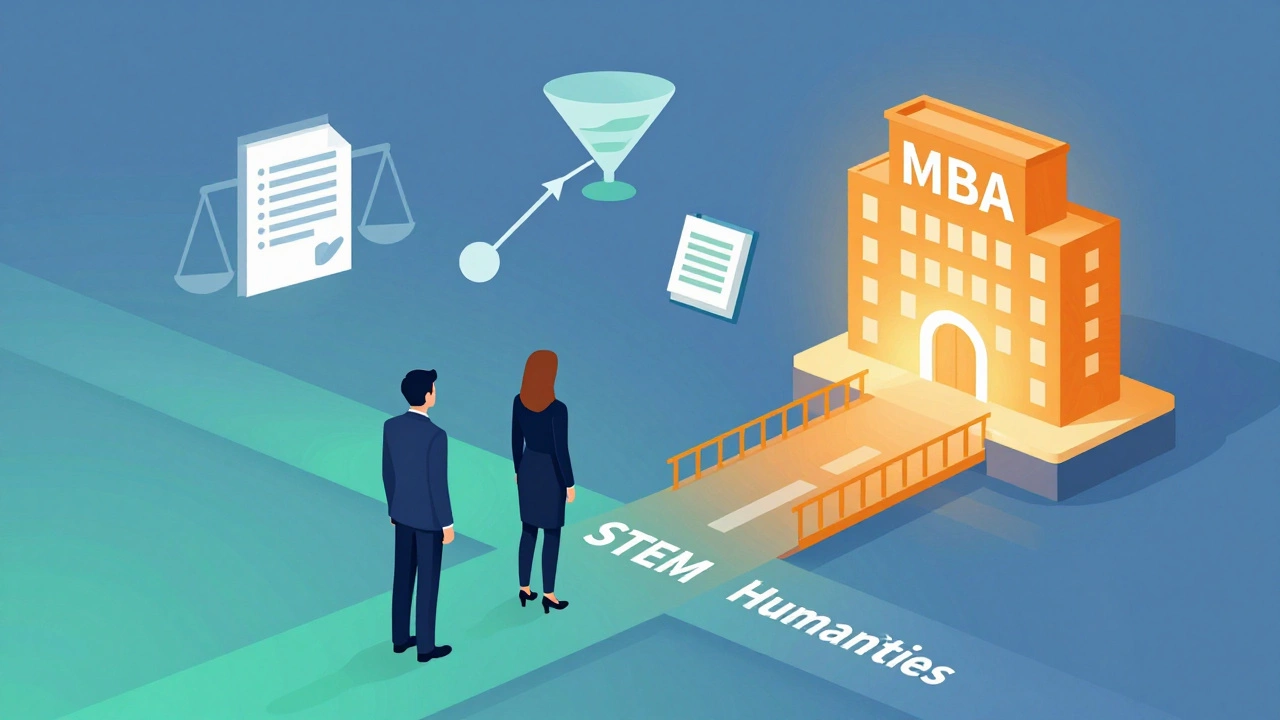
The short answer is yes. In fact, most top-tier MBA programs actively seek students who do not have a business undergraduate degree. They want diverse classrooms where engineers debate strategy with artists and scientists analyze market trends alongside marketers. Your lack of a business background is not a barrier; it can be your strongest asset if you frame it correctly.
Why Top B-Schools Love Non-Business Majors
MBA programs are designed to teach business fundamentals to people from all walks of life. If everyone applying had a Bachelor of Commerce or a Finance degree, the classroom would become an echo chamber. Admissions committees look for cognitive diversity. They want problem-solvers who approach business challenges from unique angles.
Consider the profile of a typical student at a school like Harvard Business School or INSEAD. A significant portion of their cohort comes from STEM (Science, Technology, Engineering, and Mathematics) backgrounds. These students bring analytical rigor that pure business majors might lack. Similarly, humanities graduates often possess superior communication skills and ethical reasoning, which are critical for leadership roles.
When you apply without a business degree, you are not starting from zero. You are starting from a different perspective. Schools value this because it enriches peer learning. During case studies, your ability to view a supply chain issue through the lens of an engineer or a social dynamic through the lens of a sociologist adds immense value to the group discussion.
How to Bridge the Knowledge Gap Before Applying
While schools accept non-business majors, they expect you to grasp basic business concepts quickly once you start. If you cannot read a balance sheet or understand basic marketing funnels, you will struggle in core courses. You need to demonstrate readiness.
Here is how you can build that foundation before you even submit your application:
- Online Certifications are short, focused courses that prove foundational knowledge. Platforms like Coursera, edX, or LinkedIn Learning offer certificates in "Introduction to Finance," "Marketing Fundamentals," or "Operations Management." Completing these shows admissions officers that you have taken initiative to learn the basics.
- Audit University Courses are classes you take for credit or just for knowledge at a local university. Many universities allow non-students to sit in on introductory business classes. This gives you academic credibility and access to professors who can later write recommendation letters.
- Self-Study Key Textbooks are standard academic resources used in MBA programs. Read classics like Financial Intelligence for Entrepreneurs by Karen Berman or Competitive Strategy by Michael Porter. Mentioning these books in your essays demonstrates genuine intellectual curiosity.
Do not just list these activities on your resume. Explain them in your personal statement. Tell the story of why you chose to learn accounting principles as a former history major. Show that you are proactive and capable of handling rigorous quantitative coursework.
The Critical Role of Work Experience
If you do not have a business degree, your work experience becomes your primary proof of competence. Admissions committees will scrutinize your professional history to see if you have demonstrated leadership, impact, and business acumen in your current role.
You do not need a title like "Manager" to show business sense. Look at your achievements through a business lens:
- Did you optimize a process that saved time or money? That is operations management.
- Did you lead a team project or mentor juniors? That is leadership and human resources.
- Did you negotiate with vendors or clients? That is sales and negotiation.
- Did you analyze data to make a decision? That is analytics and strategy.
Quantify your results. Instead of saying "I helped improve sales," say "I identified a gap in customer service protocols, implemented a new feedback system, and increased client retention by 15% over six months." This language speaks directly to what an MBA program cares about: measurable impact.
If your work experience is purely technical (like coding or lab research), highlight any cross-functional collaboration. Did you work with product managers? Did you present findings to non-technical stakeholders? These interactions show you can translate your expertise into business value.
Crushing the GMAT or GRE
For non-business majors, standardized test scores carry extra weight. The Graduate Management Admission Test (GMAT) or the Graduate Record Examination (GRE) serves as a neutral metric to compare applicants from different academic backgrounds. A high score proves you have the quantitative and verbal aptitude required for the curriculum.
Since you likely have strong analytical skills from your previous degree (especially if you are from STEM), the Quantitative section should be your strength. Focus heavily on mastering the math concepts tested in the GMAT, such as arithmetic, algebra, and geometry. For the Verbal section, practice critical reasoning and reading comprehension, as these assess your ability to argue logically-a key skill in business school.
Aim for a score in the 90th percentile or higher. For many top schools, the average GMAT score hovers around 720-730. Beating this average compensates for the lack of a business undergraduate degree. It signals that you can handle the mathematical rigor of finance and statistics courses without prior training.
Crafting a Compelling Narrative
Your application essays are where you connect the dots between your past and your future. You must answer the "Why MBA now?" question convincingly. Do not apologize for your non-business background. Instead, celebrate it.
Structure your narrative around three pillars:
- Past: What did you achieve in your previous field? Why are you passionate about it?
- Present: What specific skills or knowledge are you missing that prevents you from reaching your next career goal? Why is an MBA the solution?
- Future: How will you combine your unique background with business skills to create value? What industry or role do you target post-MBA?
For example, if you are an environmental scientist wanting to move into corporate sustainability, your narrative might be: "I have spent five years researching carbon capture technologies. However, I realize that great science fails without viable business models. I need an MBA to understand financing, regulatory strategy, and stakeholder management so I can scale sustainable solutions globally."
This story is powerful because it shows clarity of purpose. It explains why a generalist business degree is necessary for your specific specialist background. Avoid vague goals like "I want to be a leader." Be specific about the function, industry, and impact you seek.
| Criteria | Business Undergraduate | Non-Business Undergraduate |
|---|---|---|
| Academic Background | Familiar with core business concepts | Needs to demonstrate foundational knowledge |
| Classroom Value | Deep technical business knowledge | Diverse perspectives and cognitive diversity |
| Test Score Importance | Important for differentiation | Critical for proving quantitative aptitude |
| Work Experience Focus | Leadership progression within business | Transferable skills and cross-functional impact |
| Essay Strategy | Highlight specialization depth | Explain the pivot and unique value proposition |

Choosing the Right Program Type
Not all MBA programs are created equal. Some are more flexible for career switchers than others. Understanding the landscape helps you target schools that align with your profile.
Full-Time MBA is the traditional two-year residential program. This is often the best choice for non-business majors who want to completely pivot careers. The first year covers core courses (finance, accounting, marketing) that level the playing field. The second year allows for electives and internships, giving you hands-on business experience before graduation.
Part-Time MBA is designed for working professionals who study while employed. This option works well if you are already in a role that requires some business skills but you want to deepen them. However, it may be harder to pivot industries significantly since you remain tied to your current job.
Executive MBA (EMBA) is for senior leaders with extensive experience. EMBA programs usually require 8-10+ years of work experience. If you are a non-business major with significant leadership experience, this could be a viable path. However, younger candidates without deep executive experience should avoid EMBA programs as they may feel out of place among peers with C-suite titles.
Research each school's curriculum. Some programs offer "bridge modules" or pre-MBA summer sessions specifically for students without quantitative backgrounds. These are huge red flags if ignored-they are green lights for you. Apply to schools that explicitly support career changers.
Common Pitfalls to Avoid
Even with a strong profile, non-business applicants make mistakes that hurt their chances. Here is what to watch out for:
- Underestimating the Quantitative Rigor: Assuming that because you are good at math in your field, you will breeze through MBA finance classes. Business math involves specific frameworks and assumptions. Prepare thoroughly.
- Generic Essays: Writing generic statements about wanting to "learn business." Every applicant wants to learn business. Explain *why* your specific background needs business education to succeed.
- Lack of Recommendations: Asking recommenders who only know your technical skills. Seek recommenders who can speak to your leadership, teamwork, and potential for growth in a business context. If your boss doesn't understand your business impact, help them articulate it.
- Ignoring Networking: Thinking that getting accepted is enough. Start networking with alumni from your target schools who also come from non-business backgrounds. Their insights will be invaluable for both your application and your transition.
Next Steps for Your Application Journey
Getting an MBA without a business degree is entirely possible and often rewarding. It requires strategic preparation, honest self-assessment, and a compelling narrative. Start by auditing your current skills against the core MBA curriculum. Identify gaps and fill them with certifications or coursework. Simultaneously, begin preparing for the GMAT/GRE, aiming for a score that exceeds the school averages. Finally, craft your stories with precision, highlighting how your unique background makes you a better candidate, not a worse one.
The business world needs leaders who think differently. Your non-traditional path is not a hurdle; it is your competitive advantage. Embrace it, prepare for it, and let it drive your success in business school and beyond.
Is it harder to get into an MBA program without a business degree?
It is not necessarily harder, but it requires more strategic preparation. Top MBA programs value diversity and actively recruit students from non-business backgrounds. However, you must compensate for the lack of formal business education by demonstrating strong quantitative skills (via high GMAT/GRE scores), relevant work experience, and foundational knowledge gained through self-study or certifications. Your application needs to clearly articulate why your unique perspective adds value to the cohort.
What GMAT score do I need if I don't have a business background?
Aim for a GMAT score at or above the 90th percentile for your target schools. For top-tier programs, this typically means a score of 720 or higher. Since you lack a business undergraduate degree, a high GMAT score serves as crucial evidence of your quantitative aptitude and ability to handle rigorous coursework. It levels the playing field with applicants who have studied finance or economics.
Do I need to take prerequisite courses before applying?
You do not strictly need to take prerequisite courses before applying, but it is highly recommended. Most MBA programs assume you have basic familiarity with accounting, finance, and statistics. Taking online courses or auditing university classes in these areas demonstrates readiness and commitment. It also helps you perform better in the first year of the MBA program. Some schools offer pre-MBA bridge programs for admitted students who need additional preparation.
How much work experience is needed for an MBA without a business degree?
Most full-time MBA programs prefer candidates with 3 to 5 years of work experience. For non-business majors, quality matters more than quantity. You need to demonstrate leadership, impact, and transferable skills in your current role. If you have less than 3 years of experience, focus on highlighting rapid career progression and significant achievements. Executive MBA programs typically require 8+ years of experience.
Which MBA specializations are best for non-business majors?
Non-business majors often excel in specializations that leverage their existing expertise combined with new business skills. Common successful paths include: Technology Management (for engineers), Healthcare Administration (for medical/biology backgrounds), Sustainability/ESG (for environmental sciences), and Consulting (for humanities/social sciences due to strong analytical and communication skills). Choose a specialization that bridges your past experience with your future goals.