
NEET Preparation Phase Advisor
Find your current preparation phase and get tailored advice based on when you started and your current class level.
Most students think they need to start NEET preparation in Class 12. That’s too late. If you’re aiming for a top rank in NEET, the best time to begin is actually in Class 11-or even earlier. The syllabus covers Class 11 and 12 topics from Physics, Chemistry, and Biology, but the depth and speed required to crack NEET demand a head start. Waiting until after your board exams means you’re racing against the clock while juggling two high-stakes exams at once.
Why Class 11 Is the Real Starting Line
NEET doesn’t test memorization-it tests understanding. Concepts like chemical bonding, human physiology, and motion in a plane aren’t just topics; they’re building blocks for advanced questions. If you wait until Class 12 to start, you’re trying to learn 200+ hours of foundational material in 6 months. That’s not preparation-it’s panic.
Students who begin in Class 11 have a clear advantage. They get to absorb concepts slowly, revisit tough topics multiple times, and build confidence before the pressure of board exams hits. By the time Class 12 rolls around, they’re not learning-they’re refining. They’ve already solved 80% of the NCERT-based questions that make up 70% of the NEET paper.
Take the case of a student from Jaipur who started NEET prep in Class 11. By December of Class 12, she had completed three full revisions of Biology NCERT and solved over 1,200 previous year questions. She scored 687/720. Her secret? She didn’t cram. She built momentum.
The 3-Phase Timeline That Actually Works
There’s no magic formula, but there is a proven structure. Here’s how top scorers divide their time:
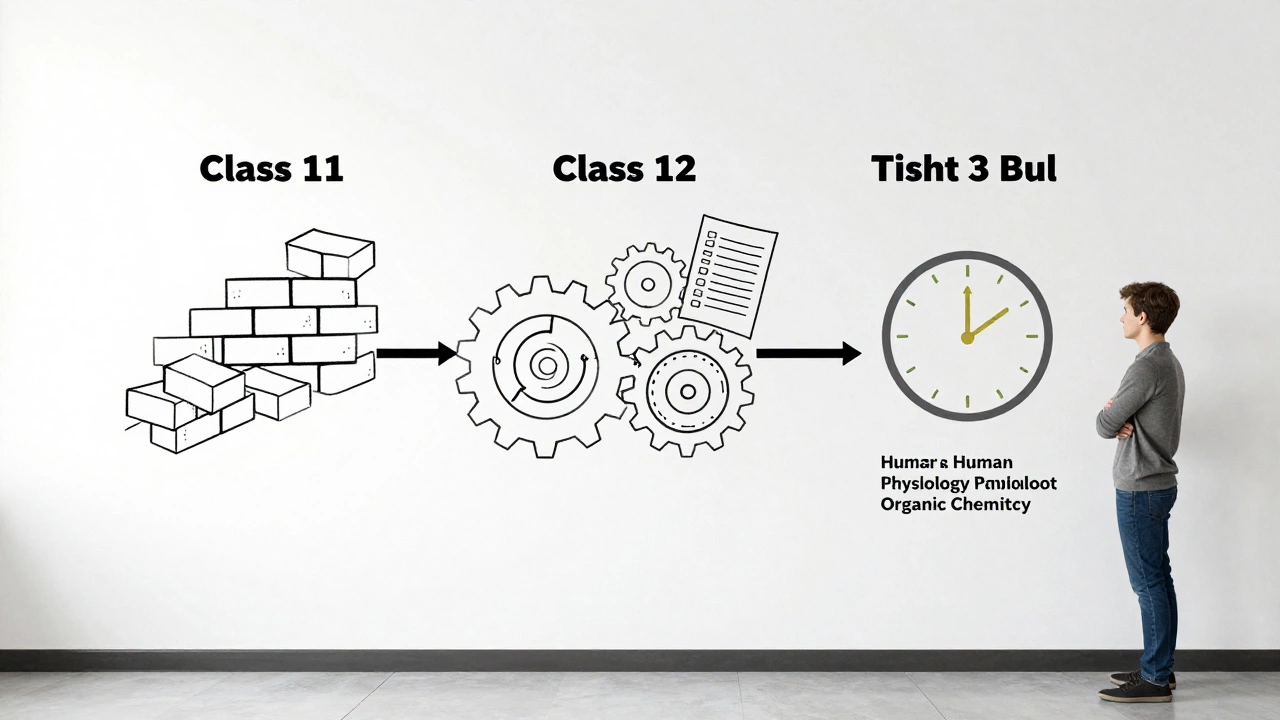
- Phase 1: Class 11 (April-March) - Focus on NCERT understanding. Don’t jump to coaching modules yet. Read every line of Biology NCERT like a story. Draw diagrams. Make flashcards for chemical reactions. Solve end-chapter questions without looking at answers. This phase is about laying bricks.
- Phase 2: Class 12 (April-October) - Now you add coaching materials, test series, and time-bound practice. Start taking weekly mock tests. Analyze every mistake. Why did you get that question wrong? Was it a concept gap? A calculation error? A misread? Fix the pattern, not just the answer.
- Phase 3: Final 3 Months (November-February) - This is about speed and stamina. Take full-length mocks every 3 days. Simulate exam conditions: no phone, no breaks, strict timing. Focus on high-yield topics: Human Physiology (20+ questions), Genetics (10-12), Organic Chemistry (15+), and Modern Physics (8-10). These areas make up nearly half the paper.
Many students skip Phase 1 and jump straight into coaching. They end up confused. Coaching institutes assume you’ve already grasped the basics. If you haven’t, you’ll fall behind fast.
What If You’re Already in Class 12?
It’s not too late-but you need a ruthless plan. You have about 8-9 months left. That’s enough if you cut the fluff.
First, drop everything that doesn’t directly tie to NEET. Social media, binge-watching, endless revision of low-weightage topics-those are distractions. Prioritize based on weightage:
- High Priority (40-50% of paper): Human Physiology, Genetics, Ecology, Organic Chemistry, Modern Physics
- Medium Priority (30-35%): Cell Biology, Plant Physiology, Biomolecules, Thermodynamics, Optics
- Low Priority (15-20%): Environmental Issues, Evolution, Chemical Kinetics, Semiconductors
Start with Biology. It’s the easiest to score in-and the most scoring. Complete NCERT Biology line by line. Then move to Chemistry: focus on named reactions and mechanisms. For Physics, master formula application. Don’t memorize derivations unless they’re directly tested.
Take a mock test every Sunday. Score it. Review it. Repeat. Top scorers don’t study more-they study smarter. They know exactly where they’re weak and fix it before the next test.

Coaching: When It Helps and When It Hurts
Coaching isn’t a requirement-it’s a multiplier. If you’re disciplined, you can crack NEET without it. But if you need structure, accountability, and test analysis, coaching gives you that.
Here’s the catch: many coaching centers push students into endless classes and overload them with material. That’s not preparation-it’s burnout. The best coaching isn’t about how many hours you sit in class. It’s about how much you retain and apply.
Ask yourself: Does your coaching help you identify your weak areas? Do they give you personalized feedback? Do they provide high-quality mock tests that mirror the actual NEET pattern? If not, you’re paying for noise, not results.
Some students switch coaching centers every few months. That’s a waste. Stick with one. Build a relationship with your teachers. Ask questions. Don’t just copy notes-understand them.
Common Mistakes That Cost Ranks
Here’s what most students do wrong:
- Ignoring NCERT - NEET 2024 had 89% questions directly based on NCERT. Skip it, and you’re guessing.
- Overdoing reference books - HC Verma, OP Tandon, and MTG are useful, but only after NCERT. Don’t start with them.
- Not analyzing mocks - Taking 10 mocks and scoring 500 each time won’t help. You need to know why you lost 20 marks in Biology.
- Waiting for ‘perfect’ time - There’s no ideal moment. The best time was yesterday. The next best is today.
- Sleeping less - Cramming till 2 AM hurts retention. Your brain consolidates memory during sleep. Aim for 7 hours, not 4.
What to Do in the Last 30 Days
In the final month, stop learning new topics. Focus on revision and test-taking rhythm.
- Revise your formula sheet daily
- Re-solve 50 high-yield questions from each subject
- Practice marking OMR sheets under timed conditions
- Review all your mock test errors-especially the ones you got wrong twice
- Keep your routine consistent: wake up, eat, study, sleep at the same time
On the day before the exam, don’t touch a single book. Walk, listen to music, relax. Your brain needs to be calm, not overloaded.
Real Results, Not Hope
NEET isn’t about talent. It’s about consistency. The student who studies 3 hours daily for 18 months will outperform the one who studies 8 hours for 3 months. Quantity doesn’t win. Quality and continuity do.
Start now. Even if you’re reading this in November of Class 12, you still have time. But don’t delay. Every day you wait is a day you can’t get back.
The best time to prepare for NEET was yesterday. The second-best time is today.
Can I start NEET preparation in Class 12 and still get a good rank?
Yes, but it requires extreme focus. You’ll need to complete Class 11 syllabus in 3-4 months while studying Class 12 topics. Prioritize high-weightage chapters, stick strictly to NCERT, and take at least one full mock test every week. Many students have cracked NEET with top 1000 ranks starting in Class 12-but they didn’t waste a single day.
Is coaching necessary for NEET?
No, coaching isn’t mandatory. Many toppers prepared solely using NCERT, previous year papers, and free YouTube resources. But coaching helps if you need structure, doubt-solving, and regular testing. The key is choosing a coaching center that focuses on analysis, not just lectures. If your coaching doesn’t help you improve your mock scores, it’s not working.
How many hours should I study daily for NEET?
Aim for 6-8 focused hours daily, not just sitting at your desk. Quality matters more than hours. Two hours of active problem-solving with full concentration is better than 6 hours of passive reading. Break your study into 90-minute blocks with 15-minute breaks. Include time for revision and mock tests.
Which subject should I start with in NEET prep?
Start with Biology. It’s the highest-scoring section and mostly based on NCERT. Once you’re confident with Biology, move to Chemistry-focus on Organic and Inorganic. Finally, tackle Physics. Physics is concept-heavy and takes longer to master, so give it time. Don’t rush it.
Is it too late to start NEET prep if I’m in Class 11 and haven’t begun yet?
Not at all. You’re still ahead of most. Start today. Complete your Class 11 NCERT in 4 months. Then move to Class 12. Use weekends for mock tests. By December of Class 12, you’ll be in a strong position. The key is consistency-not speed.
How important are mock tests in NEET preparation?
Extremely important. Mock tests aren’t just for scoring-they’re diagnostic tools. They show you where your knowledge is weak, where you waste time, and how well you manage stress. Take at least one full mock every week from October onwards. Analyze each one thoroughly. Your score will improve only when you fix your mistakes, not when you take more tests.
Next Steps: What to Do Right Now
If you’re in Class 9 or 10: Start building a habit of reading Biology NCERT. Don’t wait. Even 30 minutes a day will give you an edge.
If you’re in Class 11: Get your NCERT books. Start with Biology Chapter 1 today. Don’t buy 10 reference books. Stick to one source until you master it.
If you’re in Class 12: Stop scrolling. Open your Biology NCERT. Read one page. Write down one concept you didn’t understand. Ask someone about it tomorrow. That’s your first step.
NEET doesn’t reward the smartest. It rewards the most consistent.